UNITED STATES OF ISRAELINDEPENDENT INVESTIGATIVE REPORTING
The historical evidence atlas / 1882—2026 / 171 documentary milestones

Before the Mossad.
Before the alliance.

A century of political decisions, wartime intelligence, competing interests and state power. Follow how Zionist institutions and the State of Israel developed, how Washington entered the story, and where the archives reveal cooperation, conflict or unresolved questions.

1882 → 1948 / ORIGINS1948 → 1973 / INTELLIGENCE & WAR1978 → PRESENT / ALLIANCE & ACCOUNTABILITY
ENTER THE SOURCE TIMELINE ↘START GUIDED JOURNEY ↗SOUTHERN AIR DOCUMENTARY ↗
Source-linked documentary journey · six historical decisions

Experience the history.

Choose a chapter, follow the documented turning point, and open the original record. The animated connections are schematic, not a geographic route or evidence of a single operation.

1882DOCUMENTARY CONNECTIONS · SCHEMATIC

INSPECT THE SOURCE
Original record ↗
Open this timeline evidence ↗

MHA-48–49 / MHA-83 · Image and documentary evidence room

See the people, then read the decisions.

Archival photographs depict people and places; they cannot establish diplomatic motives by themselves. The original captions, photographer credits, archive dates and reproduction notices travel with every image. The 1948 document reader below distinguishes U.S. recognition of a state from its dealings with a provisional government.

Media-rights inspection, 11 October 2026: All ten displayed Library of Congress Matson Collection photographs have an individual original catalogue record stating “No known restrictions on publication”; the captions link to those items and distinguish documented dates from broad catalogue ranges. The eleventh image is a Truman Presidential Library recognition-draft facsimile, whose original research-file catalogue is linked here. Library “no known restrictions” notices are not an unconditional legal warranty, and no blanket permission for third-party material or unidentified individuals is claimed.

Historic stereograph showing a crowd assembled at Jerusalem railway station during the 1898 visit of Wilhelm II
October–November 1898 · Jerusalem

The city under Ottoman administration

The American Colony Photo Department photographed crowds at Jerusalem's railway station during Kaiser Wilhelm II's visit, dated by the Library of Congress to October 26–November 4, 1898.

What it does not show: the crowd's political views, religion or position on Zionism. No modern Israeli institutions existed.

Original photo and rights notice · LOC item 2019694875 ↗
Historical view of people at the Damascus Gate in Jerusalem, from a Matson Collection glass transparency
1898–1946 · date not narrowed by archive

Daily life at the Damascus Gate

This glass transparency is catalogued by the Library of Congress as the work of the American Colony Photo Department or successor Matson Photo Service; the catalog assigns a broad date interval.

What it does not show: the identity or political position of any individual. It must not be silently relabeled as a photograph from a specific year.

Original photograph and catalog · LOC item 2019702341 ↗
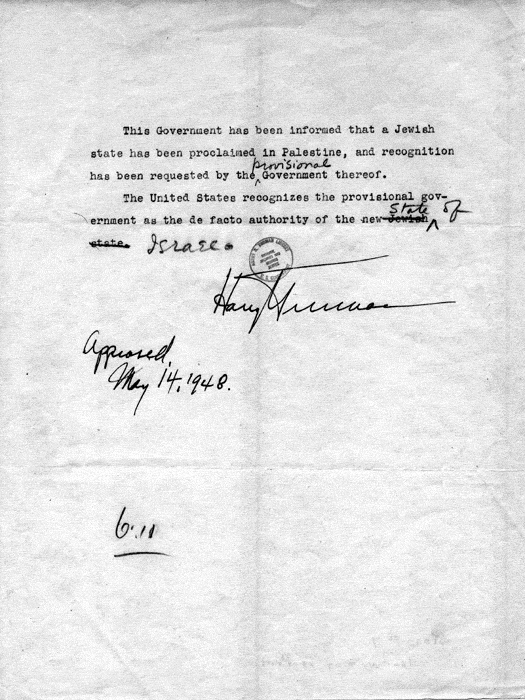
Digitized draft of President Truman's May 14, 1948 recognition statement with handwritten edits
May 14, 1948 · White House draft

Recognition in handwriting

The Truman Presidential Library exhibits a draft of the May 14 recognition statement and identifies the presidential annotations to the name of the state and timing.

What it does not show: recognition of the provisional government on a de jure basis, diplomatic relations established in 1948, or the resolution of Palestinian self-determination.

Exhibited draft · Truman Presidential Library ↗
The photographic record · eight original negatives

Palestine was a place where people lived, worked, and organized.

These dated photographs from the American Colony / Matson collection document commercial life, urban infrastructure, Palestinian political participation and British military activity. Open each item for its original catalog and rights advisory. They illuminate the setting of the diplomatic chronology; none is offered as proof of a hidden operation or as an individualized property judgment.

Haifa harbor and city seen from the slopes of Mount Carmel during the British Mandate
1934–1939 · Haifa

A harbor and its surrounding city

A view of the port and built-up city photographed from Mount Carmel during the British Mandate.

Evidence boundary: An urban panorama does not identify individual owners or determine sovereignty.

Catalog, photographer and rights · LOC 2019710152 ↗
Small cargo boats carrying wooden boxes of oranges around the Jaffa harbor breakwater in 1936
1936 · Jaffa

Orange exports and coastal livelihoods

The original Matson caption identifies orange boxes being transported by lighters toward an offshore vessel at Jaffa.

Evidence boundary: A trading photograph records economic activity, not the land titles or identities of everyone involved.

Catalog, photographer and rights · LOC 2019709020 ↗
A ship arriving in Jaffa harbor as unloading resumes after the 1936 strike
1936 · Jaffa

The harbor after the strike

The Library of Congress catalogue describes the first ship entering Jaffa harbor for unloading after the 1936 strike ended.

Evidence boundary: The photograph does not explain the causes or political agreement behind the strike’s termination.

Catalog, photographer and rights · LOC 2019708988 ↗
British troops searching residents for arms in Jaffa old town near the seafront in 1936
1936 · Jaffa

Troops searching civilians

The American Colony photographer recorded troops searching inhabitants for arms in Jaffa during the 1936 disturbances.

Evidence boundary: This is a specific police or military encounter; it cannot establish the conduct of all forces or residents.

Catalog, photographer and rights · LOC 2019708814 ↗
Members of the Arab Higher Committee leaving the offices of the Royal Commission after giving evidence in January 1937
January 12, 1937 · Jerusalem

Palestinian leaders address the Royal Commission

A dated photograph records Arab Higher Committee representatives leaving the Royal Commission after their first appearance to give evidence.

Evidence boundary: The picture documents participation, not unanimous Palestinian representation or agreement with the commission.

Catalog, photographer and rights · LOC 2019709023 ↗
Troops and cars in front of the Church of the Nativity in Bethlehem in 1936
1936 · Bethlehem

Military presence near the Church of the Nativity

The original negative shows troops and vehicles by the Church of the Nativity amid the 1936 disturbances.

Evidence boundary: Neither a particular raid nor the beliefs of people in the photograph can be inferred from this image.

Catalog, photographer and rights · LOC 2019708996 ↗
Aerial photograph from 1937 of Haifa harbor and the surrounding urban area
1937 · Haifa

Harbor from the air

A 1937 aerial negative situates the port within the city and coastal geography recorded by the American Colony Photo Department.

Evidence boundary: This image is a historical view of infrastructure, not a cadastral survey or later political boundary map.

Catalog, photographer and rights · LOC 2019707836 ↗

What, exactly, did Washington recognize?

Choose a dated government record. Each entry states its legal and diplomatic significance, along with the limitation of the evidence.

State recognition and a provisional government

The United States recognized Israel as a state, while recognizing its provisional government as the de facto authority. A May 26 State Department memorandum expressly separated recognition of the state's existence from recognition of a government de jure.

Limit: This statement does not itself demonstrate de jure recognition of the provisional cabinet or a fully established embassy relationship.

Read State Department memorandum, May 26, 1948 ↗

Media provenance: the photographs have Library of Congress catalog records listing “no known restrictions on publication,” which is not a universal rights guarantee. The Truman draft is displayed from a U.S. government archival exhibition. External hosts may move their images. No photograph is used as proof of a covert intelligence relationship. Documentation of Palestinian displacement and the 1948 war remains part of the historical chronology, independently of these images.

How to read the record

Four histories, often told as one.

There was a Zionist political movement long before Israel was established, a British Mandate and Palestinian society with their own political history, pre-state Jewish institutions with clandestine functions, and a United States whose policy changed repeatedly. Mossad's later role belongs within that sequence. The American relationship cannot be explained through one secret meeting or by treating every contact as espionage.

Follow the official memoranda, published inquiries, treaties and criminal records in chronological order. Each entry distinguishes what happened in the region, how Washington responded, and what the available record permits us to conclude. The atlas is a curated history of the institutions and bilateral relationship; it is not a complete history of the peoples of Palestine, Judaism, American politics or every intelligence operation.

Track 01 / OriginsBefore the state

Imperial policy, Zionist institutions, clandestine migration and disputed territorial claims.

Track 02 / StatecraftWashington enters

Recognition, negotiation, trade, mediation and formal interstate agreements.

Tracks 03–04 / Intelligence & accountabilityCooperation and friction

State intelligence, military aid, documented espionage, commissions and financial records.

Palestinian historical rights / primary-source reading room

Palestinians had homes, land records and demands for freedom. The historical question is what governments did with those rights.

The documentary archive records Palestinian objections to partition, displacement from homes, the existence of identifiable private property and repeated debates over compensation. It later records the International Court of Justice’s conclusion that Israel’s continued presence in territory occupied since 1967 is unlawful. A Palestinian-centered history keeps residents and their rights at the heart of decisions made by states, courts and diplomats, while distinguishing the legal scope of every source.

DECEMBER 1948The right to go home

UN General Assembly Resolution 194 (III) recommended that refugees wishing to return to their homes and live at peace with neighbours should be permitted to do so at the earliest practicable date and addressed compensation. It was a recommendation, not a judicial award of individual land titles.

Read the 1948 resolution ↗
APRIL 1964Records of Palestinian ownership

The UN land expert described using title, tax and transfer evidence to identify and value Palestinian refugee immovable property. Documentation neither gave back possession nor proved that negotiated compensation was ever paid.

Read the UN property working paper ↗
JULY 2024Self-determination and reparations

The ICJ found Israel’s continued presence in territory occupied since 1967 unlawful and identified obligations of cessation and full reparation, including return and restitution for people displaced during that occupation. The opinion did not adjudicate each 1948 property claim.

Read the Court’s summary ↗
APRIL – JULY 2024Responsibility beyond Israel

The U.S. Congress appropriated additional military financing before the ICJ stated that States must not aid maintaining the unlawful situation in occupied Palestinian territory. Comparing those documents permits scrutiny of American decisions but cannot establish the use or legality of each transfer without further evidence.

Read the American appropriation ↗

Explore the return and reparations comparison and U.S. financing comparison. These legal distinctions strengthen accountability rather than diminish the rights and experiences of displaced Palestinians.

21 October 2023 / Civilian access in Gaza

The crossing opened. The humanitarian emergency did not end.

Washington welcomed a first shipment of twenty aid trucks into Gaza. UN OCHA independently confirmed that crossing but measured the supplies at only about four percent of ordinary daily prewar imports, after thirteen days of siege. For Palestinian civilians lacking sufficient food, water, medical care, fuel and shelter, a crossing announcement was not the same as an adequate response.

20Trucks admitted through Rafah
~4%Of normal daily goods imports
100+Daily trucks UN officials said were needed
U.S. account — an important diplomatic opening

The Secretary of State welcomed the first convoy and credited diplomacy with Egypt, Israel and UN partners. The statement alone does not measure the adequacy of civilian aid distribution.

Read the original U.S. statement ↗
UN field account — the documented material shortfall

UN OCHA confirmed twenty aid trucks, equivalent to approximately four percent of normal daily prewar imports, and identified urgent humanitarian need and the absence of critically required fuel.

Read UN Flash Update 15 ↗

The percentage concerns goods-import volume, not the share of families reached or a calculation of deaths caused by the delivery gap. Compare the two original reports.

Original United Nations records / September 2024 – September 2026

The UN set a deadline. Palestinian land continued to be taken.

The United Nations General Assembly demanded that Israel end its unlawful presence in the Occupied Palestinian Territory within twelve months of September 18, 2024. Washington opposed the resolution. A year after that deadline passed, United Nations monitors were still recording settlement approvals and Palestinian families displaced through demolition or seizure. This exhibit distinguishes a legal demand, a recorded U.S. vote and separately documented conditions on the ground.

September 18, 2024 / UN General Assembly resolution ES-10/24

124Voted for the resolution
14Voted against, including the United States
43Abstained

The Assembly called for an end to Israel’s unlawful presence within twelve months. The September 18, 2025 deadline has passed. The General Assembly’s demand has a different legal status from the Court’s July 2024 advisory findings and cannot itself be described as a Security Council veto or a criminal judgment.

Read the adopted resolution ↗ Inspect the official country-by-country vote ↗

September 28, 2026 / UN Security Council briefing, reporting period June 13–September 18

Land approvals and actual displacement are different measurements.

4,570Housing units advanced or approved in Area C of the West Bank
3,515Housing units advanced or approved in occupied East Jerusalem
536Palestinian structures demolished, seized or demolished by their owners under compulsion
736People displaced, including 347 children

These figures come from a UN briefing on Security Council resolution 2334. The housing numbers are planning approvals, not completed dwellings. The demolition and displacement figures are separately reported impacts on Palestinian people and are not mathematical consequences of the housing approvals.

Read the September 2026 original UN Security Council briefing ↗
LAW AND IMPLEMENTATIONCompare the Court’s findings with the U.S. vote

In July 2024, the International Court of Justice found Israel’s continued presence in territory occupied since 1967 unlawful. The General Assembly subsequently demanded an end by September 2025; the United States voted against that timetable. These records demonstrate different institutional roles and the American recorded position.

Open documentary comparison 57 ↗
THE DEADLINE AND ITS AFTERMATHCompare the Assembly’s demand with the later UN monitoring

The Assembly requested an end to unlawful presence no later than September 18, 2025. The September 2026 Security Council report subsequently documented settlement expansion and actual Palestinian displacement, without purporting to be a final court judgment on every provision of the Assembly resolution.

Open documentary comparison 58 ↗

The public UN vote / original diplomatic record / 2023–24

Washington could veto, abstain or vote for a ceasefire text. Palestinians lived with the consequences while diplomacy continued.

Five publicly recorded votes show how the United States used its Security Council power as the humanitarian catastrophe unfolded in Gaza. The Council’s power and the American position changed by document and date, but those official records cannot prove that a vote itself stopped violence or that a proposed deal was carried out. The critical distinction is between a rejected draft, an adopted ceasefire demand, and an adopted proposal calling for phased implementation.

08 DECEMBER 2023 / 13–1–1United States vetoes an immediate humanitarian ceasefire draft

Thirteen Council members voted for draft S/2023/970; the United Kingdom abstained. The U.S. negative permanent-member vote blocked its adoption. The text also demanded civilian protection and release of hostages.

Read the unadopted UN draft ↗
20 FEBRUARY 2024 / 13–1–1United States vetoes a second humanitarian-ceasefire draft

Thirteen Council members voted for Algeria’s draft S/2024/173. Britain abstained, and the U.S. alone voted against. The text called for a ceasefire, hostage release and protection from forced displacement. The American veto stopped adoption.

Read the vetoed February draft ↗
25 MARCH 2024 / 14–0–1United States abstains on a Ramadan ceasefire demand

The Council adopted Resolution 2728 demanding an immediate Ramadan ceasefire, hostage release and increased humanitarian access. The United States abstained, and the text passed. Its adoption did not prove implementation.

Read the adopted resolution ↗
10 JUNE 2024 / 14–0–1United States backs a phased proposal for ceasefire and civilian return

The United States submitted the text of Resolution 2735, adopted with Russia abstaining. The Council welcomed a phased ceasefire proposal including the return of Palestinian civilians, Israeli withdrawals from populated areas, release of hostages and humanitarian aid distribution.

Read the adopted proposal ↗
20 NOVEMBER 2024 / 14–1–0United States vetoes a permanent-ceasefire draft supported by all fourteen others

All fourteen other Council members supported S/2024/835. The U.S. vetoed the proposal, which called for an immediate unconditional permanent ceasefire and hostage release. It remained an unadopted draft despite fourteen affirmative votes.

Read the vetoed November draft ↗

Compare December and February vetoes, June support against November’s veto, and December veto versus March abstention or March ceasefire demand against June’s phased proposal. This sequence is a record of institutional action, not a claim that a vote can quantify every life lost or a guarantee that its intended humanitarian consequences occurred.

Original White House and State Department records / 1948

Washington knew Palestinian families had lost their homes. The paperwork reveals what happened next.

In August 1948 U.S. officials counted hundreds of thousands of displaced Palestinians and warned that inadequate food, shelter and medical attention threatened lives. Dean Rusk reported that President Truman had approved seeking emergency relief and urging a return of refugees. In October, a further memorandum to Truman said the urgently needed supplies still could not be secured through existing government authority. These original records establish awareness and a gap between an approved diplomatic recommendation and adequate relief, without suggesting that presidential approval itself achieved repatriation.

19 AUGUST 1948 / DRAFT AND APPROVALDisplacement, deprivation and an oral policy decision

State Department officials estimated approximately 330,000 displaced Palestinians and warned that the supplies and nutrition available to them were inadequate. The original memorandum is undated on its face, but archival notes say it was drafted and discussed with Truman on August 19, when he gave oral approval to three recommendations.

Evidence limit: the 330,000 figure was a wartime estimate, not the total number of people ultimately displaced.

Read the original refugee memorandum ↗
20 AUGUST 1948 / RUSK MEMORANDUMHomes and belongings were already in dispute

Rusk reported evidence of Palestinian houses and household property being used by newly arrived Jewish immigrants and urged a substantial supervised return. His memorandum explicitly confirms that Truman approved recommendations the day before, but records diplomatic proposals rather than completed restitution.

Identification safeguard: the “Mr. Epstein” mentioned in this 1948 record was Eliahu Epstein of the Jewish Agency, independently named in a March 1948 State Department memorandum. He was not Jeffrey Epstein.

Read Rusk’s August 20 memorandum ↗
15 OCTOBER 1948 / RENEWED WARNINGFood, clothing and medicine had not caught up with need

Two months later, the Department told Truman that urgently needed supplies could not be furnished under existing statutory authority and that voluntary contributions were insufficient. It proposed an emergency program of up to $1.5 million in supplies and transportation while Palestinian families faced another winter away from their homes.

Evidence limit: the $1.5 million figure was a recommendation, not an audited shipment, final appropriation or delivered payment.

Read the October 15 memorandum ↗

Compare the presidential approval against Rusk’s confirmation, then follow the unresolved aid supply crisis into October. Recognition of Israel had not resolved Palestinian displacement or the rights of identifiable refugee families.

Pro-Palestinian perspective / anti-Zionist documentary history

State recognition, and the people displaced by state formation

This investigation adopts an explicitly pro-Palestinian, anti-Zionist political position grounded in Palestinian self-determination and the rights of displaced people to seek return, restitution and effective remedies. In 1919 the American King–Crane Commission recorded 222 petitions opposing the Zionist political programme among 260 received in the British-administered Palestine district. These were submitted petitions, not a representative referendum, but they document substantial political opposition among those whose homes and future were at stake. The Atlas examines the decisions of imperial governments, Zionist institutions and the later Israeli state through their effects on Palestinian land, political power and civilian life. Its criticism concerns political programmes and documented government conduct, without imputing collective responsibility to Jewish people.

In 1948, Washington recognized Israel during the war. The UN later addressed refugee return and property compensation, and the State Department acknowledged likely resistance to return. Those documents illuminate Palestinian claims left unresolved by international recognition. Jewish experiences of persecution and Jewish disagreement about political Zionism remain part of that historical context; no document here attributes collective guilt to Jewish communities.

2024 – 2026A deadline that expiredCompare the Assembly’s withdrawal demand with the later UN record of settlement approvals and Palestinian displacement.Explore the documentary evidence →JULY – SEPTEMBER 2024The Court and Washington’s voteExamine Palestinian self-determination and the U.S. vote against the Assembly timetable.Compare original UN records →21 OCTOBER 2023Twenty trucks were not enoughCompare Washington’s announcement with the UN’s record of only four percent of normal daily imported goods.Compare the original documents →AUGUST–OCTOBER 1948When approved relief was not enoughCompare Truman’s August refugee policy authorization with Washington’s October warning that urgently needed supplies remained out of reach.Compare both original memoranda →JUNE – NOVEMBER 2024When support became another vetoCompare the June American-backed plan with the November permanent-ceasefire draft backed by every other Council member.Compare the records →DECEMBER 2023 – FEBRUARY 2024The repeated ceasefire vetoRead what thirteen Council members supported twice, and why the U.S. veto prevented either draft from passing.Read the primary votes →MARCH – JUNE 2024When a demand became a three-phase proposalCompare Ramadan ceasefire language with the later U.S.-sponsored plan for withdrawals, civilian return and aid.Compare Security Council resolutions →DEC 2023 – MAR 2024The ceasefire votes Washington controlledCompare the U.S. veto with its later abstention and read what each Council text demanded for Palestinian civilians.Compare official voting records →1948 – JULY 2024Return and self-determinationCompare the 1948 UN refugee recommendation with the Court’s distinct 2024 findings on occupation since 1967.Compare the primary legal records →APRIL – JULY 2024Military financing and legal obligationsExamine the American appropriation beside duties identified by the World Court.Compare the original records →1964 – MAY 1966Whose land was counted?Compare the United Nations valuation method with the objections raised by refugee-hosting governments.Read the competing records →MAY 1966Who challenged the valuation?Contrast formal host-government criticisms with Israel’s reserved diplomatic reply.Compare the correspondence →1949 – APRIL 1964What the property records provedCompare U.S. compensation planning with the later UN attempt to identify owners and assess losses.Inspect the original documents →MAY – SEPTEMBER 1949What was Palestinian property worth?Compare acknowledged ownership with Washington’s internal proposals for partial compensation.Read the original records →MAY – JULY 1949Ownership without returnRead Israeli compensation proposals beside a U.S. consul’s account of displaced Palestinian homes.Compare the documents →SEPTEMBER – NOVEMBER 1947The federal Palestine proposalCompare the rejected committee alternative with the General Assembly partition recommendation.Inspect the original records →OCTOBER 22, 1947What Washington authorizedCompare Marshall’s vote-organizing instruction against Henderson’s objection to leading enforcement.Compare the original records →JULY – OCTOBER 1947Who would enforce partition?Compare Henderson’s warning about force with his later objections to an active American campaign.Read the original memoranda →JUNE – JULY 1947The state that was not builtRead the unpublished proposal for a single Palestine against Henderson’s four competing plans and enforcement warning.Compare the primary records →1947 – DECEMBER 1948Who was consulted?Trace Palestinian objections recorded by a consul against a later U.S. instruction discouraging discussion with Arab officials.Compare the primary records →JUNE – SEPTEMBER 1947Were Palestinians heard?Read their objections to the UN inquiry against American partition planning.Compare the original records →OCTOBER – NOVEMBER 1947How partition was decidedContrast U.S. negotiators’ working draft with the actual UN recommendation and its limits.Compare the original records →MAY – DECEMBER 1948Recognition and dispossessionCompare the original American and United Nations records and their limits.Explore the documents →DECEMBER 1948The return questionRead the UN recommendation alongside Washington’s anticipation of opposition.Explore the documents →

Provenance: UN General Assembly Resolution 194 (III) and the State Department circular of December 29, 1948. Neither record establishes that refugee return or compensation was delivered.

Primary-source close reading / Palestine, 1947

What the partition drafts actually proposed

The confidential October 24 American delegation draft dealt with control of residence, land transfers and immigration while offering minority-rights safeguards. These provisions reveal how diplomats were weighing demographic boundaries and political power in Palestine. The record is a working document with marked additions and deletions, rather than a law applied to Palestinians or the final UN resolution.

01 / Proposed residence controlsWho could establish a new home across the proposed boundaries?

The marked-up draft included a proposal requiring special administrative permission for Jews to establish residence in the planned Arab state and for Arabs to establish residence in the planned Jewish state during the transition. It does not say that everyone already living in those areas would be expelled.

Evidence: October 24 U.S. mission memorandum, transitional-period provision. A draft restriction must not be represented as the final UN requirement or evidence of implementation.

Read the marked-up U.S. draft ↗
02 / Land and migrationWhat would change regarding land transfers and immigration?

The same draft addressed Jewish immigration during the transition and proposed setting aside certain British-era limits on land transfers within the planned Jewish state. These clauses bear directly on Palestinian anxieties about land and political control, but the text contains draft edits and a footnote warning about a disputed figure.

Evidence: October 24 memorandum, transitional-period section and FRUS editorial footnotes. The numbers and altered draft text require careful treatment.

Inspect migration and land clauses ↗
03 / Equality on paperWhat protections were proposed for existing inhabitants?

The American draft also called for equal civil and political rights, nondiscrimination by religion or language, schools for minority communities and land-expropriation safeguards. Their inclusion does not demonstrate compliance, and they need to be read alongside the proposed limits on residence and the unequal power of those negotiating Palestine’s future.

Evidence: October 24 draft, constitutional provisions and minority-rights chapter. These proposed guarantees cannot substitute for investigating what happened in 1948.

Examine the proposed protections ↗
04 / The UN decisionWhich text was actually voted on?

The General Assembly’s official archive separates the adopted resolution into Part A, the partition recommendation approved by 33 votes to 13 with 10 abstentions, and Part B, an administrative funding authorization adopted without a separate recorded vote. The 1947 American delegation draft was not the text of either vote.

Evidence: UN Digital Library original catalogues for Resolution 181(II), Parts A and B, both adopted November 29, 1947.

Read adopted Part A ↗Inspect Part B ↗

The full source-to-source comparison remains available in the Decision Desk. These distinctions are particularly important for a Palestinian-centered account of what was imposed, proposed, rejected or never implemented.

State Department files / 1947

The futures officials considered before partition

Long before Israel’s declaration of statehood, Palestinian demands for independence coexisted with competing American proposals for Palestine’s political structure. The June 4 draft described a single state with common citizenship, and the July 7 memorandum compared four options. In October, a senior American diplomat warned that enforcing partition could expose Washington to military and diplomatic responsibility. These documents establish that the consequences of partition were considered in advance; they do not show that any alternative had sufficient consent or was enacted.

JUNE 4, 1947One Palestine, common citizenship

The uncleared State Department paper proposed a single independent country, federal government and nondiscriminatory citizenship for inhabitants of all faiths, with a trusteeship period before independence. Its own editorial note confirms that the draft was not cleared as U.S. policy.

Read the draft →
JULY 7, 1947Four possible arrangements and a warning

Henderson considered two single-state approaches and two partition variants. His office preferred the single-state option at that moment and warned that mass immigration or a viable Jewish state would probably need force. The memo records a contingency judgment rather than inevitable history.

Read the memorandum →
OCTOBER 22, 1947Who would carry out the plan?

Henderson opposed American leadership of the partition campaign because it could make the United States responsible for administration and enforcement, and he questioned how an exclusively Jewish police force would operate in a state with a large Arab population.

Read the objection →

These are government documents, not an assertion that Washington represented Palestinian voters or that the State Department spoke with one voice. See the constitutional alternatives and enforcement warnings in the Decision Desk.

The record after displacement / 1949

The property that did not return with its owners

The negotiations following the 1948 war separated Palestinian refugee property into questions of acknowledged ownership, physical access, compensation and resettlement. American diplomats recorded Israeli assurances that recognized proprietary rights would not necessarily restore land to its owners, while another consul described villages and homes occupied or destroyed. A later U.S. planning paper proposed a compensation process that did not expect to pay full losses. Each original document has a distinct evidentiary status.

May 10, 1949 / LausanneRecognized claims, restricted restitution

The Israeli delegation accepted compensation in principle for abandoned and formerly cultivated land while reserving control of its use and restitution. Blocked Arab bank accounts and limited family return were discussed under conditions tied to a future settlement. The telegram reported offers, not completed action.

Open the original diplomatic report ↗
July 6, 1949 / JerusalemHouses occupied and a wish to return

Consul Burdett reported that refugees wished to return and described former Arab residences occupied by immigrants or demolished. He also criticized the indirect consequences of Western relief policy. His airgram expressly labels its observations as partly speculative, limiting what it can prove without corroboration.

Read the consular assessment ↗
September 6, 1949 / WashingtonA proposal to compensate only part of the loss

The State Department memorandum described actual losses as the theoretical compensation basis, while contemplating payment of only a fraction. It proposed surveys, individual claims review and possibly collective development funds. It mentioned Sami Hadawi’s reported retention of land records, making the question of proof of ownership explicit.

Inspect the compensation memorandum ↗

Documentary boundary: these are a diplomatic account of Israeli negotiating proposals, an American consul’s partly speculative assessment, and an internal American compensation proposal. They cannot be merged into evidence of a completed payment, a universal policy, or an individually verified property claim. Compare the first two records and the compensation documents.

Original UN archive / 1964–1966

When governments could identify the land but could not settle the claims

Palestinian families had already been separated from homes, farms and businesses for years when the UN Conciliation Commission finished its technical property-identification programme. A detailed record was not the same as restitution, and its methodology later drew objections about unregistered land, reported prices and the risk that compensation would displace the right of return. Those objections and Israel’s subsequent diplomatic reply must be read as distinct institutional positions rather than conflated into an agreed settlement.

1964 / THE TECHNICAL INVENTORYWhat could the UN document?

The commission’s land expert described using Mandate-era title, tax, valuation and transfer materials to identify immovable property holdings and establish historical values. Some regions needed different methods because comparable registration records were unavailable.

Evidence limit: A land register and valuation study cannot, by themselves, prove a former owner received the land or compensation.

Read working paper A/AC.25/W.84 ↗
1966 / HOST-GOVERNMENT OBJECTIONSWhich holdings might have been missed?

Governments hosting refugees argued that unregistered or incompletely assessed holdings could be omitted, that reported transaction prices might be artificially low and that return remained a separate claim. They rejected the technical study as a complete measure of losses.

Evidence limit: The objections are diplomatic claims requiring scrutiny of original registration and market records, not an independent complete enumeration of excluded parcels.

Read objections A/AC.25/W.85 ↗
1966 / ISRAELI RESPONSEWas there an agreed valuation?

Israel’s May 23 reply called some of the objections unfounded or beyond the commission’s technical assignment and reserved its position on compensation. It did not supply an agreed replacement valuation or record completed payment.

Evidence limit: A formal diplomatic denial does not resolve the methodological objections by itself.

Read reply A/AC.25/W.86 ↗

Readers can cross-examine the valuation method and objections or the opposing official responses. The unresolved legal and historical question concerns the rights of identifiable Palestinian owners, not merely the accuracy of an accounting exercise.

Interactive archival experience / 1882–2025

The Decision Desk

Move between early American reporting on Palestine and later decisions about recognition, peace plans and normalization. Compare the source documents without implying that separate governments or decades formed a single operation.

95DOCUMENT PAIRS

Side-by-side documentary comparison
Source authority matters

What kind of document is this?

These legal and budget documents should be read in their own institutional context. Choose a source type to see what it can establish—and what it cannot.

General Assembly resolution

Resolutions record the Assembly’s decisions, recommendations and positions. Their legal consequences depend on the UN Charter and the subject; their adoption is not proof that member states implemented them.

Select a moment to compare the records.
Interactive document archive

Follow the turning points.

Select a year or choose a track. Each record shows the regional decision alongside Washington's role, followed by the documented intersection. The source links lead to original records or clearly identified institutional histories.

Follow the U.S.–Israel evidence through the archive

Choose a documentary path to compare what Washington supported, disputed or attempted to influence. The selections are editorial guides, not allegations of a single coordinated operation.

Showing the complete documentary chronology. These source links contain government documents and identified historical syntheses.

The small timeline markers are navigation controls; marker height is uniform and does not represent event magnitude or number of casualties.

CHRONOLOGICAL INDEX

Washington / U.S. record

Israel, Palestine & the region

The documented intersection

SOURCE LINK · ATTRIBUTED MATERIAL
EXAMINE ORIGINAL SOURCE ↗

A financial evidence room / Congressional Research Service snapshot / May 2025

Follow the funding. Count it once.

Select a fiscal year to inspect how the Congressional Research Service separates foreign military financing, economic assistance and missile defense. These are U.S. aid obligations, not a ledger of weapons deliveries. The table reflects the report published May 28, 2025—not a revised 2026 total.

Military assistance Missile defense Economic assistance
Recent annual figures / 2021–2025 / billions, current USD

Bar lengths share one scale, 0–$12.5B. The 1946–2020 block is a multi-year aggregate and is deliberately not plotted as an annual value.

Selected fiscal year

FY2024

$12.50B

The fiscal-year series is based on CRS source records, not a disbursement or delivery manifest.

Cumulative, 1946–2025 / current U.S. dollars

What the historical aggregate actually includes

CRS Table 1 reports approximately $174.965 billion in the three assistance categories. This aggregate already includes the annual amounts shown above. The $38B ten-year assistance memorandum and the FY2024 supplemental must not be added again as if they were separate payments beyond their constituent appropriations and obligations.

Inspect CRS RL33222, Table 1 ↗
Military $124.506BEconomic $34.348BMissile defense $16.111B

Dollar values are not inflation-adjusted. The May 2025 report's FY2025 figure is a published research snapshot, not a certified later-year outcome. Source: Congressional Research Service RL33222, updated May 28, 2025. Original CRS report at Congress.gov ↗

Reading the relationship as institutions

Connections require a documented mechanism.

The pathways shown here are analytical categories, not evidence of a single centralized network. A formal treaty, an intelligence dispute and a commercial agreement must not be connected merely because the same country appears in each record.

INSTITUTIONAL PATHWAYS / NOT A CLAIM OF SHARED COMMANDHover or tap a track below to explore
Political and state institutionsU.S. agencies and legislationPrivate and commercial actorsDocumented transactionsTreaties / memorandaOversight and source tests

The animated lines are navigational metaphors. They do not assert that every institution shown has a direct operational relationship with every other one.

Mechanism A

Public agreements

Recognition, security memoranda, treaty obligations, trade rules and appropriations have legal texts and defined parties.

Mechanism B

Intelligence & conflict

Declassified assessments, commissions and criminal cases identify specific services, personnel, questions and limits of proof.

Mechanism C

Private networks

Corporate filings, contracts and correspondence establish private relationships. An intelligence nexus needs additional records.

Documents available to the reader

Open the source room.

Selected documentary anchors from the historical atlas. The year-by-year timeline contains direct source links for every included event.

What the host filters mean: “Official institutional hosts” identifies the publisher of the linked page, not independent verification of every statement or an official endorsement of the interpretation here. Government archives can contain privately authored emails, press claims and working drafts. “Research and document mirrors” can preserve released records but require comparison with the government or archival original before attributing authenticity. A source-link entry is not itself proof of the historical inference.

Source accessibility audit · October 11, 2026

Gate 1 · primary-document provenance register (11 October 2026)

Current inventory: 171 dated milestones, 264 distinct indexed source destinations, 148 documentary evidence records and 95 comparison scenes. Earlier source-availability surveys on this page describe smaller inventories at the time of their testing. Their success and exception counts must not be projected onto all 264 present links. A listed destination records documentary relevance; it does not certify the link was manually opened, that a scan was visually inspected or that the document establishes every associated interpretation.

Original scanned page visually inspected: 42 Stat. 1012, September 21, 1922, H.J.Res. 322, original page image. The resolution favors a Jewish national home while requiring protection of the civil and religious rights of Christian and other non-Jewish communities in Palestine. This congressional endorsement was neither an international treaty nor an instrument granting territorial sovereignty. Two additional visually checked pages are recorded in the existing Gate 1 audit below: a 1981 Reagan Library memorandum and the May 2025 CRS RL33222 Table 1; those are page spot-checks rather than complete PDF authentications.

Government textual reproduction, original source identifiable: State Department FRUS editorial reproduction of the 1949 Clapp interim report was readable, including its recommended relief costs and ration distinctions. This is an official State Department published transcription or reproduction, not an independently authenticated scan of every page of the UN document.

Institutional document identity and catalogue records: UNRWA A/1451/Rev.1, A/1905 and A/2978 were catalogued in earlier checks; the underlying original PDFs were not all visually authenticated. The later UNCCP reports A/3199 (1956) and A/6225 (1965) are indexed as official archival records. An official UNISPAL HTML transcription of A/3199 records £2,633,175 released through August 1956; a separately indexed UN-language reproduction of A/6225 records £3,588,008 by July 31, 1965. These are figures reported by the Commission, with different reference dates and scope; claimant-level disbursement and underlying PDF scans have not been authenticated here.

Official institutional disagreement / retrieval exception: The Navy's 2017 H-Gram 007 reports 34 killed and 171 wounded in the attack on USS Liberty; a later Navy overview reports 34 killed and 170 wounded. Both source identities remain indexed, and the timeline preserves the discrepancy. This browser's current attempts timed out or returned gateway errors; institutional-site transport failure is an access exception, not evidence of falsification and does not resolve the historical dispute.

Gated originals and independent mirrors: DOJ EFTA00810711 and EFTA02634615 official releases may invoke age-verification challenges. Identical file identifiers on research mirrors do not establish byte-for-byte equivalence or chain of custody, and external reproductions require comparison to accessible originals before scan-level certification. Personal contacts, account identifiers and information about survivors or private parties should not be copied from originals or mirrors into this publication.

Outstanding certification limitation: The prior 175-destination sweep recorded 22 method-specific exceptions; later composite sweeps reached smaller source inventories and do not constitute a new 264-link verification. Complete URL-by-URL status classification and source-to-claim provenance traceability, outstanding original-page inspection for financially or legally consequential evidence, authenticity of mirrored scans, and cross-document privacy review are still open. Gate 1 remains uncertified, as do Gates 2–6. The original audit results and historical access-exception history follow below.

A fresh October 11, 2026 HTML-browser accessibility scan attempted all 175 source destinations indexed at the time of that sweep. Of these, 153 returned substantial page content, 14 could not be rendered using this method (including PDF content and intermittent State Department responses), seven returned an institutional access challenge or restriction, and one produced a retrieval failure. These 22 exceptions are not findings that the sources are false or inaccessible through every method. Several official FRUS documents were independently readable through a second retrieval system, and the three March 1957 withdrawal records remain available through the original United Nations catalogue pages. An additional check of six newly indexed April–May 1948 official sources found four substantive archival pages and two UNISPAL institutional access restrictions. The blocked endpoints are also documented by the accessible FRUS originals and UN Digital Library meeting catalogue. These later results are not part of the original 175-source sweep. An October 11 post-addition source check separately attempted 11 new May–June 1949 archive destinations: eight returned substantive pages, two UNISPAL pages returned institutional access restrictions, and one FRUS page failed this browser renderer but was readable through independent retrieval. Across 192 current destinations, the documented browser-method results therefore total 165 substantive page renders and 27 access exceptions, counting the earlier 175-destination sweep and separately examined additions. Six additional original State Department documents from June–September 1949 were each opened and returned substantive original-archive HTML pages. The combined access checks therefore cover 198 indexed destinations, with 171 substantive rendered pages and 27 browser-method exceptions from earlier checking. One newly indexed original FRUS mediator-mandate reproduction has since returned a substantive archival page. Eight additional November–December 1949 destinations have also been tested: four FRUS originals and two UN Digital Library committee catalogues rendered substantive pages, while the UNISPAL Clapp report URL and UNRWA institutional presentation returned browser-access challenges. The already-indexed official UN Resolution 302 catalogue independently renders. Across the 207 previously indexed destinations, the documented checks total 178 substantive rendered pages and 29 method-specific exceptions. A subsequently added U.S. GAO 2026 funding audit page was opened and read separately; it is the 208th indexed destination. This adds one substantive web render to the earlier 207-destination check, for a cumulative 179 successful browser renders and 29 method-specific exceptions. These are retrieval results, not 208 independent source authentications; linked scans and a full content review remain outstanding. Since the original 208-destination access tally, fifteen additional URLs have been attempted separately; nine returned substantial official archival or catalogue pages and six encountered institutional access restrictions or PDF-rendering failures. Across the 223 current source destinations there are therefore 188 substantive page renders and 35 method-specific exceptions in these composite scans. Nine new 1953–54 source destinations were attempted for MHA-122–124: four official institutional archival or catalogue pages rendered substantively and five UNISPAL pages returned browser access restrictions. The current 234-destination composite record therefore totals 192 substantive page renders and 40 method-specific exceptions, which is not equivalent to 234 fully authenticated documents. Those figures do not independently authenticate every record, nor resolve the original PDF page-image exceptions. A successful render does not validate every historical inference.

Verified replacements: three 1957 UN documents (A/3568, SG/566 and A/3943) now open to their authoritative UN catalogue pages instead of raw PDF links that repeatedly failed in a browser. Independently recovered: the 1946 Acheson–Truman FRUS statement, the 1949 Lausanne FRUS document and the 1957 Dulles FRUS memorandum remained valid government documents despite transient failures in one browser channel. Remaining limits: some PDFs cannot be rendered by HTML-only testing, three Justice Department Epstein Library documents invoke age verification, the October 2023 archived State Department site intermittently fails, and two 2025 UN press pages demand browser challenges. External email reproductions must never be represented as a government-authenticated original merely because an EFTA identifier is printed in the file.

These limitations affect access and provenance, not by themselves the truth or falsity of the historical claim. The restored original article, its three documentary images, source PDF, social-card image and favicon now use Cloudflare-hosted asset routes. The original September 2026 Netlify archive remains preserved for disaster recovery; the published article has no remaining Netlify-hosted asset URLs.

Access exceptions and sensitive documentary material

All 175 source destinations were retested in this edition. The 22 browser access exceptions comprise 14 nonrenderable responses, seven challenged or restricted pages, and one failed retrieval. A document hosted by a government may require an age gate or a PDF reader, and the UN press archive sometimes presents a browser challenge even when its original meeting and draft records are available.

The published Atlas text and restored original article contain no email addresses or North American telephone-number patterns in the tested text. Eleven historical Atlas images loaded successfully and carried alternative descriptions. Original documentary images and third-party EFTA file reproductions can contain more personal information than is displayed in the article text; a published archive does not authorize republishing contact details or exposing protected survivors. A manual inspection of all source document pages and the article exhibit pixels remains necessary for unconditional sensitive-person approval.

Original Department of Justice records should be attributed to the Justice Department release archive, while external mirrors are labeled as reproductions. Inclusion in a document, private financial correspondence, or similarity of names does not prove trafficking, criminal participation or intelligence control.

Publication safeguards and original-document boundaries

An October 11, 2026 scan examined rendered text across thirteen published routes, including the historical Atlas, original article and four-part Mossad Files. It found no visible email-address or U.S.-telephone-number patterns and no broken image alt-text fields on those pages. All eleven photographic Atlas exhibits loaded with alternative descriptions in a separate desktop image check. The public reporting does not quote unpublished contact information or present a private person’s inclusion in an archive as proof of wrongdoing.

Important scope limit: this automated check does not inspect every individual page of each linked PDF, or prove that email screenshots and external archives contain no sensitive identifiers. Those manual document and media inspections, assistive-technology testing and survivor-centered review remain pending for unconditional final approval. Reporters and readers should not redistribute personal identifiers from linked original records.

PUBLICATION VERIFICATION / 11-REVIEW REQUIREMENT

What has been checked, and what remains open

Financial accounting review — verified for the published financial figures. The 2021–2025 fiscal-year aid series and the 1946–2025 cumulative obligations are reconciled against the Congressional Research Service’s May 28, 2025 Table 1. The 2016 $38 billion memorandum, the April 2024 $3.5 billion supplemental appropriation, the 1991 $10 billion loan-guarantee dispute, the Walsh Iran–Contra accounting and the 2026 SEC acquisition disclosures were cross-checked with their original or formally reproduced records. The 1957 $125 million bases rumor remains correctly characterized as a claim Dulles denied, not as a payment.

These amounts measure different things. A proposed memorandum, legal budget authority, financial obligations, weapons deliveries, business-combination cash paid and accounting consideration must not be added as though they were interchangeable. The CRS figures remain a dated May 2025 snapshot rather than an audited October 2026 lifetime total.

Historical chronology review — checked and date-reconciled. The original chronology audit covered 109 events; the current 143 milestones remain in the same chronologically rendered Atlas, subject to final post-addition date checks using their archival years, months and days. Original diplomatic-source review found that the August 1948 Truman memorandum is undated in its body but drafted August 19 and corroborated by Rusk’s August 20 memo; the UNSCOP report was signed August 31, 1947 and published in September. The reference audit checked the 45 original FRUS-linked timeline entries, 61 previous other-source entries and the newly verified October 21, 2023 UN OCHA field update; 52 returned substantive readable pages and nine had restrictions, PDF browser shells or transient retrieval errors. The new December 23, 1981 item uses Reagan’s publicly readable archival interview. Those ten remain source-authentication exceptions, not claims that dates are false or manuscripts independently authenticated.

Publication status: the original October 11 MHA-83 release receipt recorded PASS for chronology (02), narrative development (07) and reading progression (09); PASS — SCOPED for legal and evidentiary distinctions (05); PASS — AUTOMATED for interactive evidence (10); and CONDITIONAL for source authentication (01), financial accounting (03), current accountability (04), privacy (06), final human writing (08) and adversarial review (11). Subsequent work strengthened financial checks, source retrieval and chronology through 118 events, but it did not confer unconditional sign-off on all 11. For final unrestricted approval, eight workstreams remain open or only partially cleared: 01, 03, 04, 05, 06, 08, 10 and 11. The historical PASS findings for 02, 07 and 09 remain dated to their audited release and require final regression against later edits, not a false claim that every new sentence received human editing.

See the eight outstanding or partially cleared mandatory reviews
  1. 01 — All original sources authenticated document by document (open)
  2. 03 — Complete financial transaction reconciliation beyond the scoped published-figures audit (partial)
  3. 04 — Current accountability and developments, with dated 2026 source check (open)
  4. 05 — Legal and evidentiary distinctions, full-text contested-claim review beyond scoped comparisons (partial)
  5. 06 — Survivor and private-person protection on every published page and image (open)
  6. 08 — Human line edit of all original research and connected articles (open)
  7. 10 — Manual assistive-technology, keyboard and media-rights verification after automated passes (partial)
  8. 11 — Independent adversarial documentary review and final sign-off (open)

Review records remain dated and explicitly scoped. A verified archival webpage is not itself corroboration of every inference drawn from it. The former Netlify project is a preserved backup, not the public deployment.

2019 Carbyne warrants correspondence: what the archived text establishes

In the March 2019 released email chain, attorneys sought the controlling person’s identity for bank compliance. Participants stated that Southern Trust had transferred US$2.4 million as its part of an investment and that US$3.6 million in requested funds had reached the receiving account. These are distinct statements about the transaction, not amounts to add together as two additional payments.

The original Justice Department EFTA02634615 file requires age verification for some readers; its eight-page external reproduction was separately inspected as a PDF, including the correspondence on pages 1, 3 and 4. Personal contact details are not republished here. Assertions of intelligence control, criminal conduct and current ownership are not established by the emails. Compare these emails with the 2016 partnership agreement.

How to interpret the original documents

The 1983 Israeli Kahan Commission report is now linked to its report text as reproduced in an academic documentary collection. Its dated inquiry found indirect Israeli responsibility for the Sabra and Shatila massacre while limiting its investigation to the September 1982 events; the republication is not a second independent inquiry.

The 2016 Southern Trust and SUM limited-partnership agreement is linked through an accessible external reproduction and its U.S. Department of Justice file (age verification may be required). The 2019 bank-and-warrant correspondence remains indexed via another external reproduction. These records concern commercial rights and banking information; they do not themselves establish continuous ownership, government intelligence direction or criminal culpability.

Official publication, archival transcription, externally hosted document and historical interpretation represent different provenance categories. Access to a webpage does not mean a document is independently corroborated.

These are distinct destinations, not a count of independent corroborating sources. Official hosting does not guarantee a record proves every claim; external mirrors may reproduce government documents. Some sources support multiple milestones, and 102 indexed destinations provide supplemental research, provenance and visual evidence beyond the chronology.

Editorial audit, October 11, 2026: all timeline URLs are now indexed. Two source-provenance labels have been corrected. A sample of original records and the CRS fiscal table was checked against their published text. The prior 138-destination accessibility sweep returned 118 substantive pages and 20 access exceptions. The previous 208-destination index had a composite browser-access check with 179 substantial renders and 29 access exceptions; six added official destinations have not yet been covered by the same sweep. These results do not establish comprehensive source authentication, underlying PDF-page review, or independent historical-inference certification.

Targeted documentary audit after MHA-112 (not a new historical research pass): The June 2016 SUM partnership PDF was examined at the original contract ownership table: Southern Trust holds 33.33% of partnership interests and 66.67% of preferred rights; the general partner controls ordinary business decisions subject to contract safeguards. The released 2019 correspondence reports $3.6 million received into an Ergo account but remains an externally reproduced email, without independent bank or final share-register confirmation. GAO-26-107939 Table 1 independently supports the stated $624 million allocation, $528,322,771 obligations, $181,292,757 payments and $95,677,229 expired unobligated balances. Sensitive data in linked external scans and the full chain of custody remain outside this scoped check. Audit 01, Audit 03, Audit 05 and Audit 06 remain open for comprehensive independent sign-off.

Mandatory editorial audit: live verification status · 11 October 2026

11 October 2026 · Gate 2 complete original-URL access sweep for monetary narratives: Screened all 171 source-linked milestones for numerical, budget, appropriation, obligation or funding language. Fifty-eight milestones met that scope and pointed to fifty-three distinct original URLs. Each of the fifty-three URLs was requested in a live browser, and all fifty-three returned a substantive original publisher, institutional HTML, original report catalogue or PDF-reader page. The 1948 U.S. State Department FRUS d542 initially produced a short browser response but subsequently rendered successfully in two independent retries and contained the contemporary 330,000-refugee figure. Separately conducted direct content checks of twelve high-consequence original sources, verifying the 2016 U.S.–Israel memorandum’s $38 billion with its $33 billion and $5 billion components, the 2024 $3.5 billion appropriation, GAO September 2026 Palestinian assistance’s $624 million allocation and distinct obligation and disbursement figures, the Axon SEC acquisition amounts, and the 1949 FRUS Export–Import Bank temporary-allocation pause rather than cancellation. Link accessibility is a completed regression for this 53-URL set only: it is not proof that every figure in all fifty-eight milestones has been independently checked against every PDF page or receipt, nor that the legal implications have received independent sign-off. Those substantive financial/legal checks and the other final-certification work remain explicitly OPEN.

11 October 2026 — Combined Gate 2/Gate 3/Gate 4/Gate 5 closeout work, limited and attributed: Recomputed archive integrity across 171 milestones, 264 unique sources, 148 evidence records and 95 documentary comparisons: zero missing registered milestone/evidence URLs, zero invalid comparison indices, zero duplicate source URLs and zero timeline records without a year. Fifty-eight money/funding-associated milestones were identified for detailed adversarial checking; a targeted institutional-source sample of twelve rendered substantial original pages, including the U.S. 2016 $38 billion memorandum, the 2024 supplemental appropriation, September 2026 GAO allocation/obligation/disbursement distinctions, original FRUS 1949 Export–Import Bank memoranda, a 1952 relief resolution and Axon’s 2026 SEC filing. The 1949 loan original recorded a $100 million authorized Export–Import Bank programme and $49 million not yet allocated; the temporary pause was not cancellation, and a later Haifa allocation was treated separately. The 2016 $33 billion and $5 billion funding components were verified as a proposed ten-year aid understanding, not ten years of paid receipts. Exact historical accounting and application of legal standards still require line-by-line comparison of the remaining identified cases; catalogue access alone cannot validate UN scanned table totals. Ten original Library of Congress Matson photographic item pages were independently checked and each carried the individual “No known restrictions on publication” advisory. Image captions already identify the Matson archive; corrected the final Truman recognition-facsimile link from a generic museum artifact page to the relevant original research-file catalogue. Corrected a documentary record that misidentified a linked official DOJ original as a mirror; retained official and independent reproductions while adding clear cautions about private contact and financial instructions in the released PDFs. These constitute substantial audit work but not authentication of all external scans, manual screen-reader testing or independent editorial/legal approval. No claim of closing all eleven required audits or all six certification gates is made.

Gate 3 and Gate 5 / complete Experiences external-link regression · 11 October 2026: Every one of the 24 distinct original publisher or platform links presented in the Voices/Experiences library was fetched through the automated browser: 23 returned substantive publisher or YouTube pages with identifying titles. One MSF West Bank article on the psychological effects of settler and military violence displayed a connection-verification challenge under automated access; the original URL was retained without asserting a broken publisher page. The library continues to use platform-hosted media and labels its external reporting; this test is not independent image/media licensing permission, review of private content in every linked document, an end-to-end embedded playback test or manual screen-reader certification. The privacy, permission and human QA gates therefore remain open.

Six-gate consolidated technical regression, October 11 2026: The current 171 milestones, 264 source destinations, 148 documentary evidence records and 95 comparison scenes were checked for missing source references, evidence-title links, reading-path targets, comparison index validity, duplicate titles and duplicate source URLs; no such structural defect was found. Automated pattern screening of event and documentary summary text found no obvious e-mail, U.S. Social Security or North American telephone patterns. All nine principal public routes rendered on a mobile browser. The common site shell previously lacked a semantic main landmark on the home page and a focusable skip link across its subpages; the former is now wrapped in main and a shared skip link and main-content target have been added. This review improves Gates 4 and 5 and does not clear the original PDF page authentication backlog, externally linked private information, manual assistive-technology testing or an independent reviewer. The six sign-off packages remain formally open.

11 October 2026 · Gate 1 original UN institutional reader and 1949 Lausanne provenance repair (PARTIAL): Checked nineteen different United Nations Digital Library institutional catalogue pages, each providing substantial archival metadata and original scanned-language download references. The twenty older UNISPAL source entries now open those nineteen individually confirmed accessible official readers while visibly preserving their original archival URLs and labels in the source room. Two separately signed Lausanne records are both reproduced in UNCCP’s A/927, annexes A and B, whose official 1949 report is now the main milestone and documentary opening destination. This reproducing original report is not identical to the individually signed summary minutes or a final treaty; the American FRUS contemporary telegram remains separately indexed. Added two further UN catalogues not previously present, the adopted Resolution 513(VI) and the official 1955 UN Yearbook. Underlying original PDF pages, privacy, full legal claims, manual accessibility and independent final approval still require review; none of the six final certification gates is represented as complete.

Gate 1 supplementary original-page verification: Visually inspected the 17 December 1981 original Haig-to-Reagan memorandum at printed PDF viewer page 9 in the Ronald Reagan Presidential Library declassified NSC agency file; the document confirms a temporary decision not to proceed with the strategic memorandum in response to Israel applying its law to the occupied Syrian Golan Heights, while explicitly maintaining the underlying security commitment. The scanned text also shows proposed Security Council wording was negotiated; this is not proof of a permanent end to U.S.–Israel security cooperation. Visually inspected page 1, Table 1, of the original Congressional Research Service report RL33222, updated 28 May 2025: cumulative nominal U.S. assistance obligations through FY2025 total $174,965.110 million, and the FY2024 row is $12,500.000 million, including $6,800.000 million military assistance and $5,700.000 million missile defense. This table describes obligations within defined categories, not cash paid on publication day or an October 2026 lifetime audit. Alongside the already checked 1922 Statutes at Large page, three distinct original PDF pages now have documented visual spot verification; the remaining original PDF pages and all institution-gated sources remain open Gate 1 work.

Gate 1 scan and provenance receipt, scoped: The original 1922 Congressional Statutes at Large page 1012 was independently inspected in page-image form, confirming the condition concerning civil and religious rights of non-Jewish Palestinian communities. Original institutional UN catalogue pages for A/1451/Rev.1 (1950), A/1905 (1951) and A/2978 (1955) rendered, but PDF downloads returned access restrictions, so the contents of those originals have NOT all been page-image authenticated. The 2017 U.S. Navy H-Gram 007 says USS Liberty suffered 171 wounded; a newer NHHC overview says 170. Both original institutional references are now indexed with the difference made explicit in the timeline. This correction and metadata review do not resolve all older source-access exceptions or finish primary-scan certification. All six final certification gates remain open.

11 October 2026 — Gate 1 original-source provenance and adopted-vs-proposed authority audit D (PARTIAL): Verified official UN Digital Library archival catalogues for 1948 Second Special Session annexes A/S-2/Annexes (record 807241, containing the 20 April American working paper A/C.1/277) and the original First Committee report A/552 (record 1324890). The 20 April 1948 milestone and its evidence record now open the official UN annex; the earlier April 2 U.S. FRUS drafting record remains indexed as distinct original source. The American draft was never enacted as a Palestine trusteeship. Separately verified the original official UN published texts for distinct adopted November 27, 1953 Resolution 720(VIII) Parts A and B (catalogue records 666060 and 666061), their separate Assembly votes (A 52–0–5, B 51–0–6), and their different legal subjects: A covered UNRWA funding and agency mandate, B concerned adding up to two Advisory Commission members. Repointed the existing 1953 relief-programme milestone and evidence link to the original Part A without discarding the earlier U.S. State Department FRUS reproduction. Four original UN catalogue destinations were added, two milestone/evidence links corrected, no new duplicate historical events and no unverified promise that programme targets became cash disbursements. Official catalogue checks establish institutional source identity and document access rather than every scan page’s visual authenticity. Gate 1 and the five other sign-off packages remain OPEN.

11 October 2026 — Six-gate adversarial production audit, scoped results: Gate 1 tested fifteen high-priority official source pages (thirteen substantial pages; two inaccessible UNISPAL transcripts with original UN Digital Library catalogues available), attempted all ten directly indexed PDF URLs by browser (six PDF-renderer exceptions, three DOJ age gates and one external reading page), and independently inspected the original 1922 congressional scan with the documentary viewer. Gate 2 reviewed the 1922 public resolution, 1955 UNRWA report, 1957 U.S. foreign-policy memorandum, 2024 ICJ advisory and 2026 GAO categories; it corrected the incorrectly implied audit status of the 1955 UNRWA report. Gate 3 scanned all 171 timeline summaries, 148 evidence records and eleven inline image descriptions; of twenty-four unique Voices publisher links, twenty-two returned substantive pages, with one timeout and one connection challenge. Gate 4 reconciled all event/source links, editorial paths and comparison references while retaining Palestinian first-person and displacement history; a full human prose edit is still required. Gate 5 records previously verified keyboard/mobile interactions and the latest 390px/1440px layout and accessibility-markup checks; no manual screen-reader certification was performed. Gate 6 remains an independent reviewer’s sign-off and has not occurred. None of these scoped technical checks clears inaccessible scans, external media licensing, full manuscript readability or independent human assurance. Final editorial certification is withheld.

11 October 2026 — MHA-135–136 and original-document finance/legal adversarial review, Gate 1 PARTIAL: Reconciled the 1954 UNCCP thirteenth report A/2629 and separate formal corrigendum A/2629/Corr.1 with official UN Digital Library originals, without claiming their scanned pages were fully inspected. Added the original fifteenth and twenty-third reports, A/3199 (1956) and A/6225 (1965), together with two historical milestones, three source-matched evidence records and two interactive comparisons. The 1956 report reproduces an Israeli diplomatic position linking refugee land-compensation plans to other governments’ policies, and a later UN objection; separately it records £2,633,175 in released refugee and absentee accounts through August 1956. The March Israeli letter claimed more than £4 million but its accounting basis was not reconciled to the UNCCP amount. The 1965 Commission report tabulates one £3,588,008 cumulative paid bank-balance total, comprising £740,408 from the 1953 stage, £2,801,009 under the 1954 programme and £46,591 under its extension. It simultaneously reports no progress implementing paragraph 11 of GA194(III). These are separate bank-deposit and land/return categories; neither amount establishes restored property rights or household-level receipt for every claimant. Added four official UN catalogues, original scans still require full page-image and sensitive-data assessment, and all six independent final certification gates remain OPEN.

11 October 2026 — Gate 1 archival-document reader remediation C (PARTIAL): Rechecked four original milestone and paired evidence links concerning Palestinian frontier villagers, the economic exclusion of Gaza residents, displaced Azazmeh Bedouins and a 1951 armistice commission repatriation vote. The original UNISPAL transcript URLs (1955 A/2978/Add.1 and 1951 S/2388) both served a publisher access-error page in the tested browser, whereas the matching United Nations Digital Library catalogues, records 712887 and 479809, returned full official document identification and downloadable language-specific scanned original references. All four primary timeline and evidence source links now open the official accessible catalogues while both original institutional UNISPAL addresses remain indexed for provenance; added one new catalogue URL because S/2388 was already in the source register. The official record 712887 title contains an erroneous reference to General Assembly resolution 919 (IX), but the actual 1955 special report identifies its commission under resolution 818 (IX); that metadata defect is explicitly noted rather than reproduced as fact. This reader-access repair does not authenticate every original PDF page, the separately signed May 1951 commission minutes, an actual Azazmeh repatriation, or independent aid eligibility for all affected Palestinian communities. Gate 1 remains open with source scan and other reader exceptions; the remaining five certification gates likewise remain open.

MHA-134 / firsthand media attribution and editorial enhancement · 11 October 2026: Added the original MSF Gaza medical staff documentary, official verified channel version and a dated evidentiary distinction between first-person testimony and adjudicated findings. The pre-existing Voices page was expanded with three MSF channel video embeds, eighteen externally linked documentary/interview/podcast accounts, West Bank interviews, and the original Sabra and Shatila reporting. Editorial summaries include publisher attributions; the site does not rehost third-party videos or newly disclose patient contact information. These scoped attribution/privacy/reading improvements do not certify external-media permissions, comprehensive linked-document privacy, or manual screen-reader testing; all six final sign-off gates remain governed by the existing acceptance ledger.

11 October 2026 — MHA-134, original-document provenance and adversarial legal accounting (scoped Gate 1): The UN Conciliation Commission’s fourteenth progress report A/2897, issued 3 March 1955, provides primary institutional testimony that a May 1954 bank-loan proposal resolved the stated currency obstacle to releasing refugees’ blocked accounts, while the subsequent Israeli proposal for additional depositor negotiations was criticized by the Commission as departing from its 1952 currency-only agreement. The record also describes earlier funds transferred to banks, which cannot be equated with payments received by named account holders. Added one milestone, one source-matched evidence record and one cross-document comparison against the 1952 continuation of the Commission’s mandate without introducing a new source URL. A previous Azazmeh comparison was corrected because it wrongly implied the 1951 armistice decision existed in the Atlas only as a 1955 UNRWA quotation; the contemporaneous UNTSO S/2388 Security Council transmission is separately indexed and corroborates its existence. This does not authenticate separately signed commission minutes, original 1955 scanned PDF pages or final individual account outcomes. All six publication-certification gates remain OPEN, including Gate 1 original-page inspection and sensitive linked documents.

11 October 2026 — Gate 1 original-source reader remediation, batch B (PARTIAL): Verified two inaccessible UNISPAL primary-source entry points by actual browser checks: UNRWA 1955 annual accounts A/2978 and UNCCP 14th report A/2897. Original UNISPAL pages returned publisher access-error HTML, while matching official UN Digital Library catalogues at records 712884 and 1307499 opened successfully with document identity, original archival metadata and scanned-document access. The timeline and associated evidence records now open these authenticated official catalogue entrances; original UNISPAL addresses remain indexed separately. The 1955 UN General Assembly Resolution 916(X) statement that repatriation or compensation had not been effected was checked against the Yale historical reprint and the UN official 38–0–17 December 3 vote register. No new MHA number was used and no historical claims about actual cash transfers or delivered Palestinian restitution were inferred. Two original links have been remediated, one new catalogue was registered, and the older 21 scan/reader exceptions logged after other concurrent review remain OPEN. Full linked scan-page privacy, provenance and the other five final certification gates remain OPEN.

Gate 1 scoped accession and source-path review, 11 October 2026: Five newly indexed 1951–55 archival references were checked with the same automated browser: the original FRUS editorial note and the UN Digital Library S/2388 catalogue returned substantive content, while three UNISPAL HTML endpoints returned institutional access restrictions. The S/2388 original scanned PDF also generated a browser-renderer error, so its individual page images have not been fully authenticated. The official UN Digital Library catalogue was added as a stable alternative document entrance without removing the UNISPAL original; the current index now has 249 destinations. These checks advance but do not close the primary-scan certification gate, nor the remaining privacy, independent legal, editorial and manual-accessibility gates.

MHA-133 — recovered contemporaneous UN Security Council provenance, 1951: Directly reconciled the November 3, 1951 original UNTSO S/2388 transmission with the UNRWA 1955 special report’s later account of the Azazmeh. The official 1951 Security Council report records the Egyptian–Israeli Mixed Armistice Commission’s May 30 majority finding and repatriation ruling, the dissenting Israeli counterproposal and the June 4 appeal. UNRWA later reported the appeal withdrawn. This strengthens the provenance chain beyond a later quotation, but neither source verifies whether the directed repatriation occurred or replaces the separately signed commission minutes. One primary-source event, documentary record and comparison were added; final original-page and legal sign-off remains open.

11 October 2026 — MHA-130–132, primary 1955 UNRWA special report and mandate-adversarial review: Original A/2978/Add.1 was reconciled with the adopted December Resolution 916(X), the State Department historical editorial note and the UN 1955 Yearbook. Three documentary milestones record the frontier villages that retained homes but lost more than one million dunums and 90% of irrigated land, the economic disenfranchisement of unregistered original Gaza residents, and the agency’s retrospective quotation of a 1951 Azazmeh repatriation direction. A three-percent frontier survey sample and nonmatching categories of registered refugees were preserved as explicit limitations. The 1955 resolution did not extend UNRWA regular aid eligibility to every claimant; private groups and governments were appealed to instead. Full authentication of the separately signed 1951 armistice minutes, page-image review of original UN scans, complete linked-document privacy checks and independent legal review remain open. The corpus now contains 166 milestones, 247 source destinations, 142 evidence records and 91 scenes.

11 October 2026 — Gate 1 primary-document provenance, source-page check A (PARTIAL): Visually examined three original government-document PDF pages that the historical HTML-browser method had classified as PDF/format exceptions. The 1922 Statutes at Large page 1012 verifies Public Resolution 73, its approval on September 21 and the civil/religious safeguard language without an express guarantee of Palestinian national political rights. The declassified December 17, 1981 Alexander Haig memorandum at Reagan Library PDF page 9 verifies suspension of proceeding with the particular U.S.–Israeli strategic MOU over Israeli annexation of the occupied Syrian Golan Heights, while explicitly retaining wider U.S. security commitments. The original May 28, 2025 CRS RL33222 PDF Table 1 (PDF page 6) confirms $174,965.110 million in cumulative 1946–2025 U.S. aid obligations, including military $124,506.200 million, economic $34,347.500 million and missile defense $16,111.409 million, which are not disbursements. Updated three archival descriptions and the 1967 USS Liberty milestone to the exact Navy-documented 171 wounded alongside 34 deaths. The U.S. Navy historical article remains inaccessible to both HTML-based retrieval methods, so the documented original U.S. Navy access exception is not marked resolved, and the contested question of intention is not decided. Of the 24 earlier access/method exceptions, three original PDF pages have now been visually verified, leaving 21 earlier entries requiring equivalent original-source or reader review: 7 other PDF/restricted, 13 institutional access challenges and 1 Navy reader. The newer indexed sources beyond that historic sweep remain subject to the full 244-source provenance and privacy audit. This is source audit work toward Gate 1, which REMAINS OPEN, alongside the other five final certification gates.

11 October 2026 · Production integrity and acceptance-gate reconciliation (no new historical MHA): After concurrent research additions through MHA-129, rechecked all 163 historical milestones, 244 distinct source destinations, 139 documentary evidence records and 88 comparison scenes. All milestone and evidence title links resolve, every comparison record index is in range and the source register contains no duplicate entries. Repaired the only evidence source mismatch: an archived September 14, 2016 White House fact-sheet URL with an unnecessary trailing slash now matches the original canonical entry indexed elsewhere in the archive. Reconciled initial static comparison and supplemental-source counters (88 and 87 respectively). In independent live mobile (390px) and desktop (1440px) scripted interaction tests, the 163-item chronology and 244-item registry render, Qibya and Palestinian-rights search/period filters narrow and reset, both tabbed controls move selection by keyboard and comparison navigation advances; no horizontal page overflow was observed. Eleven static image descriptions are present, with no duplicated document IDs, missing internal anchors or inspected new-window rel=noopener safeguards. Automated personal-contact-pattern screening found no obvious email addresses, U.S. SSNs or North American phone numbers in published milestone and documentary summary fields, but this does not clear linked scans. This completed scoped production-integrity and interaction regression is not manual screen-reader clearance.

Final-certification ledger: SIX required work packages, now individually assessed and documented. These are named acceptance gates, not an estimate of the number of conversations or a license to keep creating historical MHA passes. A finding requiring a correction remains inside the gate that discovered it; the sign-off total changes only after a gate is evidenced and approved.

  1. Gate 1 — Primary scans and provenance: PARTIAL; ORIGINAL PAGE AND INSTITUTIONAL CATALOGUES CHECKED, FINAL OPEN. The 257 indexed sources have passed structural integrity checks; fifteen priority original institutional pages were tested, thirteen rendering substantial content while two UNISPAL transcript endpoints returned restricted pages despite working UN Digital Library catalogue alternatives. Ten direct PDF URLs were examined for automated accessibility; the browser presented six blank/minimal PDF views, three U.S. DOJ age-verification pages and an external document-reader page. The original 1922 U.S. Statutes at Large image was separately inspected and verified through the source PDF reader. The historic twenty-four exceptions and the underlying page-image inspection of other scanned sources remain open; a catalogue render is not independent authentication of a complete PDF.
  2. Gate 2 — Full financial and legal challenge: PARTIAL, FINAL OPEN. Rechecked the 1922 Congress resolution on an official scanned primary page, 1955 UNRWA annual-report budgets and actual expenditures, the original November 1957 FRUS resettlement proposal, the ICJ original advisory case and the 2026 GAO financial table. Corrected the 1955 UNRWA milestone’s unsupported implication that its cited annual report itself is an independently authenticated audit opinion. The GAO FY2022–24 categories remain allocation $624m, obligation $528,322,771, disbursement $181,292,757, unobligated $95,677,229, and unliquidated obligations $347,030,014. The full 171-event substantive and cross-site legal challenge remains open.
  3. Gate 3 — Privacy and media permission: PARTIAL, FINAL OPEN. Screened 171 event summaries and 148 Decision Desk records for obvious email, U.S. SSN and North American telephone patterns with none found. All eleven original inline Atlas images have alt text, appear with external originating catalogue/credit links, and all inspected external-window links carry noopener. Of 24 unique external links in the published Voices/Experiences collection, twenty-two returned substantial publisher pages, one request timed out and one presented a connection-check page. The four video embeds do not autoplay or reproduce raw files. Linked financial PDFs and sensitive survivor or private-party scans are not fully inspected or cleared for publication of identifying details, and independent media-rights verification remains open.
  4. Gate 4 — Continuous editorial and Palestinian-centred narrative: PARTIAL, FINAL OPEN. Reconciled every published milestone with its indexed source, every evidence record with its milestone, every reading-path title and all ninety-five scene indices. Corrected a source-description overclaim concerning the UNRWA 1955 annual report without removing Palestinian financial dispossession, the history of return and compensation or documented institutional responsibility. A full reader-centered prose edit across the 171-record chronology, 148 evidence records, all comparisons and connected feature articles remains to be performed as a coherent pass, including the Palestinian-centred house-style review.
  5. Gate 5 — Assistive technology and cross-device manual QA: PARTIAL AUTOMATION, HUMAN TEST OPEN. Automated interactive checks have previously demonstrated functioning mobile and desktop filtering, keyboard navigation and no horizontal overflow. Current static checks confirm eleven inline alternative texts, no duplicate HTML IDs, working event/source/path/comparison references, and no new-window noopener omissions; the Experiences media collection also renders at 390px and 1440px without layout overflow, broken section anchors or autoplay. A screen-reader user must still independently test announcements, focus order, touch, reduced motion, video accessibility and complete route journeys. Automated results are not a substitute.
  6. Gate 6 — Independent adversarial review and final approval: OPEN, EXTERNAL SIGN-OFF REQUIRED. An internal adversarial challenge has now produced an actual financial-source attribution correction and identified persistent original-scan and publisher-link access limitations, all documented above. A reviewer independent of the research, writing and engineering must still challenge the complete source chain, legal/financial claims, survivor protections and editorial bias. No independent reviewer has signed off, and this assistant’s audit cannot be represented as independent human approval.

Current status: The website is live and the production regression is scoped cleared; six certification gates remain open. A browser link’s apparent functionality is not a finding of primary-document authenticity. Final approval is pending, and these gates may contain multiple corrections without changing their number.

11 October 2026 — MHA-126–129; historical evidence, fiscal classification and adversarial legal attribution: Compared 1955 UNRWA A/2978 audited accounts ($36,203,256 rehabilitation budget; $6,941,075 spent; $4,062,134 operating deficit) with the December 3 adopted Resolution 916(X), which expressly recorded the failure of refugee repatriation and compensation and the unmet needs of several additional populations. Compared an October 2, 1957 Dulles-approved recommendation to continue UNRWA support under Section 407 with separate November 21 Villard and Wilcox memoranda showing disagreement over immediate diplomacy and proposed bilateral projects whose resettlement objective would remain unstated. Preserved the distinction between committee and final Assembly votes, statutory consideration versus automatic cutoff, a proposed $17.8 million pledge versus money actually paid, and confidential proposals versus implementations. The 1955 UN report transcription, UN catalogue, GA resolution transcript and official U.S. FRUS documents were accessed, but underlying UN scanned PDF pages and all other linked source PDFs have not received full visual authentication. Six of the seven new source destinations returned substantial pages in the Cloudflare browser renderer: the official UN Digital Library A/2978 catalogue, U.S. State Department FRUS documents 378, 407 and 408, the UN Dag Hammarskjöld Library vote register and the Yale archival reproduction of the adopted text. The UNISPAL A/2978 original-document transcription returned a browser access restriction but could be read via an independent web retrieval method. These are six access results and one browser-method exception, not authentication of all original scanned pages. This is substantive new documentary work, not final eleven-audit certification.

11 October 2026 · Scoped legal-evidence audit, Palestinian-centred editorial review and chronology-filter regression, without new MHA identifier: Verified the original October 18, 1953 U.S. diplomatic response to the Israeli attack on Qibya against the independently adopted November 24 Security Council Resolution 101 and its 9–0–2 vote. Strengthened the pre-existing Qibya milestone without changing its title, date, stable identifier or primary U.S. record, adding an official FRUS reproduction of Resolution 101, its UN Digital Library catalogue, two evidence records and a comparative documentary scene. Four new 1953–54 entries used a nonselectable “afterwar” era key; their era-filter assignment is repaired to the existing 1953–67 historical period, without changing evidence IDs. Rewrote the Palestinian-rights introduction to explicitly establish a pro-Palestinian, anti-Zionist standpoint grounded in the original King–Crane petitions and their nonrepresentative sample, and updated the research notebook and static counters. Both new primary-source readers rendered successfully in a live official-archive browser check. This is scoped source-level and editorial corrective work, not full independent manual verification of all 237 destinations or complete eleven-audit approval.

11 October 2026 · Complete historical source-access sweep and archival reader corrections (publication audit; no new MHA research identifier): An exhaustive 225-destination HTML browser pass against the pre-MHA-122 register, with seven targeted ambiguous-source retests, yielded 201 substantial archival/institutional readers, ten PDF or gated-document endpoint exceptions, thirteen institutional web-access challenges and one repeat Navy-history network failure. These method-based exceptions do not mean source falsification and do not establish scanned-page authenticity. Official reader paths have now been reconciled for the 1948 U.S. Palestine trusteeship proposal through the FRUS April 2 original draft (the source editor records minor revisions before the April 20 UN presentation), the November 1949 Clapp report A/1106 through the official UN scanned-document catalogue (November 16 covering letter, November 17 circulation), and December 1949 UNRWA Resolution 302(IV) through the authentic General Assembly catalogue. The inaccessible institutional original URLs remain retained as archival entries. Reconciled each timeline record, evidence-record title, source destination and indexed documentary comparison without changing research identifiers. A 2016 White House official fact-sheet reference was found to have a harmless trailing-slash mismatch, not a missing archival document; normalizing URL comparisons resolved it without a duplicate source. The additional 1953–54 sources were separately audited by concurrent MHA-122–124 work. Legal-adversarial independence, visual PDF examination, sensitive external scans, manual assistive technology and continuous editorial polishing remain open.

MHA-125 and original-document adversarial audit 01 / 05 / 06 / 11: The externally accessible EFTA00810711 reproduction was read against the printed contract sections and visibly checked on scanned pages bearing the economic-rights table, general-partner authority, protective approval rules, Barak succession clause and signature lines. The document explicitly names Ehud Barak in conditional succession and describes Southern Trust’s preferred rights, but does not establish execution by every partner, implementation of a replacement, a continuously verified ultimate beneficial-owner register or government intelligence command. Source EFTA02634615 has been reviewed on selected scanned pages: it contains contact details and statements about reported transfers, but is not independent bank proof; contact details have not been republished. Complete linked-document page-by-page privacy inspection remains open. The historic archive has 159 milestones, 234 indexed source destinations, 132 evidence records and 84 comparison scenes.

Post-MHA-124 source-access and fiscal adversarial receipt: Among nine new 1953–54 documentary destinations, four original FRUS/UN Digital Library source pages rendered and five UNISPAL transcript endpoints were refused by this automated browser. Together with the previous documented 223 destinations, source-access results for the 234 destination register total 192 substantial page renders and 40 browser-method exceptions. The 1953 General Assembly $292.8m programme authorization, 1954 $111m agreement ceilings, $6,992,513 project commitments and $3,574,823 agreement-based expenditure represent non-additive accounting measures. The UNCCP one-million-pound first-stage agreed bank release and approximately three-quarter-million-pound bank turnover are also distinct. Open verification obligations include the original PDF page scans, external mirrored files and the remaining full legal and survivor privacy red-team audit.

11 October 2026 · MHA-122–124 / financial, property and source-provenance checks: New original 1953–54 records compare large UNRWA development-programme agreement ceilings with auditor-defined direct project expenditure, subsequent Assembly acknowledgement that planned projects were not executed as expected, and a separately documented release of some Palestinian refugees’ blocked bank deposits. The 1953 agreed £1m first stage was different from later reported bank availability of about £0.75m. The archive now contains 158 milestones, 234 indexed source destinations, 130 evidence records and 83 documentary comparison scenes. Final original scan-page verification, privacy review and all eleven unrestricted editorial approvals remain outstanding.

11 October 2026 · Mandatory reading progression and interaction audit: Reviewed 154 milestone-to-era assignments. The legacy founding tab labeled 1948–49 incorrectly included nine records dated 1950, 1951 or 1952. A dedicated 1950–52 period button now exposes those nine records and the legacy tab label has been corrected to 1948–52. The new filter reuses the existing timeline renderer, retains all original milestone/source identifiers, and requires no alteration of evidence texts or links. This is a scoped repair, not complete clearance of the eleven publication audits. Later MHA-122–124 source additions have not received full scanned-PDF visual inspection; the financial figures are sourced to UN archival transcripts and official UN Digital Library report catalogues, with unavailable scan pages transparently recorded.

11 October 2026 — MHA-121; substantive financial, archival-access and interactive chronology audit: Independently matched original UNRWA first annual report A/1905 against the previous 1950 interim report, preserving the differences between a $54 million cash-kind-services target, $37.1 million freely disposable, an earlier separate $38.0 million cash pledge schedule and $9.4 million early receipts. Preserved concurrent MHA-120’s different 1952 annual accounts. The 17 newest original links were tested by a live browser: eleven substantial institutional archive/catalogue renders, five blocked UNISPAL HTML hosts and one original scanned PDF beyond the HTML renderer. Added two working UN Digital Library catalogue destinations and repaired three primary original-document entry points for 1950 resolutions 393(V), 394(V), and UN report A/1451/Rev.1 without deleting their original UNISPAL index entries. Found and corrected nine historical events assigned the unsupported chronology-filter code “afterwar”, reassigning the existing founding-era filter only; all event titles, dates, provenance identifiers and comparison indices remain unchanged. Repaired a static Decision Desk counter that displayed 79 when data already contained 80 scenes, and set the next published count to 81. Previously tested mobile and desktop search and source filtering with zero horizontal overflow; a fresh release regression remains required. The full 208-link historical exception revisit, independent scan-level privacy review, screen-reader review, complete narrative re-edit and independent adversarial legal review remain open.

MHA-120 new source review: MHA-119 already independently indexed the January 1952 Assembly budget and therefore was not reproduced or renumbered here. The distinct 1951–52 UNRWA annual accounts document current-programme promises, cash actually received and a separately classified annual income statement. The 223-source index includes fifteen additions since the 208-destination baseline; nine of those added URLs returned substantive official catalogue or archival content and six returned method-specific access challenges. A full original PDF page-image, survivor privacy and editorial audit remains open.

11 October 2026 — MHA-117/119; scoped evidence, finance and legal audit: Matched the conditional 12 October 1951 U.S. confidential draft against two separate adopted General Assembly resolutions on 26 January 1952, correcting the potential false implication that a proposed transfer of Palestinian compensation to UNRWA ever replaced UNCCP’s institutional mandate. Distinguished Resolution 512(VI), adopted 48-5-1, from Resolution 513(VI), adopted 49-0-5. In the latter, a $250 million multi-year plan, adjusted $27 million and minimum $50 million first-year programme targets, and the $118 million 1952–53 approved budget are overlapping programme categories, not independent amounts of cash spent. Three events, three evidence records, two documentary comparisons and five destinations were added. Reconciled all original event URLs, every evidence-to-milestone title and all comparison indices; repaired an older ICJ title punctuation mismatch. Static checks of visible Atlas narrative and records found no email-address, U.S. Social Security-number or North American phone-number patterns; these limited text-pattern checks do not certify linked document privacy. Pending: complete primary-document visual inspection, cross-site continuity, full assistive-technology testing and independent adversarial review.

11 October 2026 — MHA-115/116 and scoped Audits 01, 03 and 05: Rechecked the UN original A/1451/Rev.1 cash table and programme request against the 2 December 1950 adopted Resolution 393(V), correcting a material omission of the distinct at-least-$30-million reintegration provision. Examined the U.S. FRUS reproduction of the 7 November four-sponsor draft and its record of the Pakistani non-prejudice amendment, Iraqi criticism and Israeli reservation. Added two primary-source milestones, two Decision Desk records, two comparisons and two distinct source destinations without renumbering any existing record. The original UN scanned-PDF screenshot facility returned a cache error although the 22-page document text was retrievable; visual-page review, the full bibliography access sweep, financial regression and independent legal adjudication remain open. The archive now has 149 milestones, 216 indexed destinations, 121 records and 77 comparisons. These are scoped evidence corrections, not full clearance of the eleven mandatory audits.

The eleven mandatory reviews are now measured against 171 published milestones, 264 distinct indexed source destinations, 148 evidence records and 95 comparisons. Earlier receipts with smaller numbers are dated historical snapshots and must not be mistaken for current-edition audit clearance. Earlier release PASS and scoped records remain historical receipts, not automatic clearance of material added afterward. Latest evidence verification corrected an important 1949 ration-accounting conflation: Appendix B to A/1106 records 940,000 authorized UNRPR ration strength but distributions reaching 1,019,000 recipients, distinct from 726,000 displaced people, 751,000 including border-line cases, and 652,000 judged eligible for direct relief. See the original FRUS reproduction and the original UN report, Appendix B, p. 22.

  1. 01 · Primary-source authentication — PARTIAL, NOT SIGNED OFF. Direct-checked the original 1949 UN economic survey and its Appendix B figures, the original FRUS U.S.–British November 1949 policy annex, the institutional Resolution 302 record and the original 2024 ICJ opinion. Source-host accessibility is not independent provenance or authenticity of all 208 documents. Unopened original scans and noninstitutional reproductions remain exceptions.
  2. 02 · Chronology — HISTORICALLY SCOPED CLEARANCE, REGRESSION OPEN. Prior 109-event date review and subsequent 143-entry structural checking; full original-date comparison of later additions is not signed off.
  3. 03 · Financial accounting — HISTORICALLY SCOPED CLEARANCE, REGRESSION OPEN. The May 1949 proposed $49 million Export-Import Bank hold remains distinct from the August allocation pause and September project concurrence, none of which is a disbursement ledger. September 2026 GAO ESF allocation, obligation, disbursement and expiry are separate categories and figures.
  4. 04 · Current accountability — PARTIAL. Cross-checked the September 23, 2026 GAO-26-107939 official report against the published FY2022–2024 figure and May 2026 accounting cutoff; this does not establish a complete October 2026 accountability sweep.
  5. 05 · Legal and evidentiary attribution — PARTIAL, NOT SIGNED OFF. Checked the 2024 ICJ original opinion (occupied Palestinian territory since 1967, advisory opinion with stated obligations for third States); the 1948 General Assembly refugee resolution and 1949 Resolution 302 mandate are different instruments. A General Assembly vote against a draft is not a permanent-member veto; a 1949 UN admission is not a later criminal conviction or an automatic mechanism to revoke membership. Full line-by-line claim review remains open.
  6. 06 · Survivor and private-person protections — PARTIAL, SCOPED MARKUP REVIEW. This edition was checked across 143 timeline milestones, 115 Decision Desk records and the delivered Atlas HTML. No published email addresses or U.S. Social Security number patterns were found in those fields; 11 static photographs have alt text, and the publicly named individuals in reviewed Epstein-related summaries are discussed as figures in documents rather than assigned criminal responsibility by association. The 223 currently indexed source destinations and original PDF page images have not all been examined for survivor identifying data, private contact information, or sensitive third-party records. A full privacy and minimization sign-off remains OPEN.
  7. 07 · Narrative development — PREVIOUS PASS, FINAL RE-READ OPEN. Earlier release reviewed the human chronology; later passages require one continuous reader-centered edit.
  8. 08 · Human writing and editorial style — OPEN. Complete paragraph, repetition, attribution and diction review awaits final manuscript freeze.
  9. 09 · Reading progression — SCOPED CHRONOLOGY FILTER CORRECTION, FINAL REGRESSION OPEN. All 154 published milestone era tags were compared to their visible filters. The prior filter labeled 1948–49 also contained nine 1950–52 entries. The label now accurately covers 1948–52, and an additional 1950–52 Refugee rights period control provides direct access to the nine postwar records without changing their underlying source IDs, metadata or original category assignment. Browser selection and reset states were tested; complete narrative sequencing and screen-reader evaluation remain open.
  10. 10 · Interactive evidence and accessibility — SCOPED KEYBOARD AND STATIC-MARKUP CORRECTION, MANUAL OPEN. The legal-authority four-tab selector now implements roving tabindex, selected-tab labels and Arrow/Home/End keyboard navigation with focus carried to the chosen tab. Static checks found no duplicated id attributes, no missing alt attributes among 11 inline photographs, no new-window anchors missing rel=noopener in the inspected template, and an existing skip-to-main link and reduced-motion rules. The 223-link archive, all scripted filters, screen reader announcements, device touch interactions and external multimedia are not yet exhaustively tested.
  11. 11 · Independent adversarial editorial review — OPEN. This check caught a material 1949 ration accounting error and stale milestone/source counters; independent source-by-source falsification, legal challenge and full cross-site adversarial sign-off have not been completed.

Approval status: NOT FINAL. The running Atlas is published for access, but no unconditional eleven-audit editorial certification is asserted. Historical research identifiers remain unchanged; this correction is an audit, not an additional investigative pass.

AUD-06 / AUD-10 scoped release · 11 October 2026: Checked 143 milestone narratives, 115 primary-record comparison summaries, 11 static image alternative descriptions, external-window link attributes, unique markup identifiers and public contact-data patterns. Repaired the legal-authority tab keyboard interaction without changing the underlying historical evidence. These targeted tests do not clear survivor privacy in every linked PDF or constitute a full assistive-technology certification. The eleven mandatory editorial reviews remain individually tracked above.

Original-source provenance boundary (11 October 2026): The archive currently indexes 264 sources for 171 milestones; its new Navy original is an additional source destination, not a new historical milestone. Three old PDF browser-method exceptions now have direct original-page visual checks: 1922 Congressional Statutes, 1981 Reagan Library memorandum, and May 2025 CRS funding table. Twenty-one original exceptions remain unverified by equivalent visual or substantive reader review (seven other PDF/gated, thirteen institution-hosted access errors, one official Navy page timeout); later documentary sources retain separate source receipts. A visually inspected page does not certify every other page in a document or full archive privacy and copyright compliance.

20 legacy UN archival reader entries now have a working official alternative. The original UNISPAL addresses remain in the indexed archive and appear on their corresponding cards. Selecting a source card opens its verified United Nations Digital Library catalogue, including the 1949 Commission report reproducing the separately signed Lausanne protocol annexes. Original-page visual and survivor-privacy examination remains open.

Private-document safety: Some officially released correspondence, particularly EFTA02634615 and EFTA00810711, contains contact details, signatures and financial-transfer instructions. Documentary links remain available for source checking, with the official U.S. Department of Justice release indexed alongside external reproductions. The investigation deliberately does not republish personal contact details, bank routing information or private wire instructions, and inclusion in a correspondence chain does not itself establish wrongdoing.

Source control: government archival documents, official institutional histories, and clearly attributed reports are labeled separately. Archival silence cannot establish that an event never occurred. A private actor's contacts or a shared political objective do not prove recruitment, command, intelligence funding or wrongdoing.

CONTINUE TO THE FOUR-PART MOSSAD INVESTIGATION →
Historical atlas / investigative research notes / updated October 11, 2026

What this edition added

This source-controlled research notebook preserves the existing investigation and sequential historical passes through MHA-136. The latest original-document work examines the 1953–54 gap between announced UNRWA development programmes and actual project spending, the partial release of Palestinians’ frozen bank deposits, and the documented investor rights in a 2016 agreement. The present audit further compares the 1953 Qibya diplomatic statement with the adopted Security Council condemnation, retaining Palestinian civilian losses and the failure to establish restitution as central to the historical account. Earlier research on the 1949 refugee emergency, the 2016–2019 SUM investment records and the September 2026 GAO accounting remains preserved. Independent verification of every external source remains unfinished. A pass counts only when it produces a new sourced record, a correction, a working feature or a verified technical result. The existence of a research pass is not a claim that the entire historical archive has been exhausted.

  1. MHA-01 — 1948 refugee-policy provenance. Integrated the December 29, 1948 FRUS circular airgram and distinguished the UN resolution from implementation.
  2. MHA-02 — 1953 Qibya diplomacy. Added the U.S. press statement and its immediate civilian-protection and diplomatic significance.
  3. MHA-03 — 1975 American leverage. Integrated Ford-era National Security Council minutes on the policy reassessment and deliveries.
  4. MHA-04 — 1981 MOU interruption. Added a declassified Haig memorandum and documented the contemporaneous suspension of implementation.
  5. MHA-05 — 1991 Madrid economic pressure. Added the State Department's account of loan-guarantee pressure and Palestinian representation.
  6. MHA-06 — Interactive source pathways and release QA. Added traceable source labels, curated comparison pathways, editorial version control and responsive behavior checks.
  7. MHA-07 — 1919–1942 provenance. Integrated 1919 mission cables, 1939 White Paper and immigration correspondence, and 1942 Biltmore reporting.
  8. MHA-08 — 1946 colonial endgame. Integrated Anglo-American inquiry correspondence, Britain's request for American troops, the American planning response and the King David Hotel consular report.
  9. MHA-09 — Alternative futures in 1947. Compared the uncleared June draft favoring one Palestine with the later State Department partition position.
  10. MHA-10 — Negotiating land and implementation. Integrated October boundary decisions and the December Jewish Agency meeting.
  11. MHA-11 — The 1948 record. Integrated the provisional refugee-relief estimate, recognition clarification and White House–State policy call.
  12. MHA-12 — Interactive historical comparison. Built and tested eight clickable source pairs, cross-references, mobile reading and primary-document links.
  13. MHA-13 — 1988 Palestinian diplomacy. Verified and integrated Reagan's authorization for substantive U.S.–PLO dialogue; distinguished dialogue from state recognition.
  14. MHA-14 — Jerusalem Embassy Act. Integrated the 1995 U.S. statute, including the gap between congressional policy and the subsequent executive decision.
  15. MHA-15 — Two-state framework and deadlines. Compared the 2002 Bush presidential vision with the 2003 Quartet Road Map and its unfulfilled 2005 target.
  16. MHA-16 — Settlements and UN voting. Integrated UN Security Council Resolution 2334, including the recorded U.S. abstention and the resolution's subject.
  17. MHA-17 — Jerusalem and normalization. Integrated the 2017 U.S. proclamation, 2017 UN response, 2018 embassy opening and 2020 normalization treaty, keeping different legal instruments distinct.
  18. MHA-18 — Diplomatic decisions interactive edition. Extended the source comparison desk with seven new scenes, added a guided diplomacy trail, and conducted staging and publication checks.
  19. MHA-19 — 1949 refugee relief authority. Added the original UN General Assembly resolution establishing UNRWA, differentiating institutional creation from political settlement.
  20. MHA-20 — 1967 and 1974 UN legal frameworks. Integrated Security Council Resolution 242 and General Assembly Resolution 3236, with source-type and implementation limits.
  21. MHA-21 — 2004 international judicial findings. Integrated the ICJ wall advisory opinion and distinguished the occupied-territory route from construction inside Israel.
  22. MHA-22 — Budget and oversight instruments. Compared the 2016 White House security-assistance MOU with the additional $3.5 billion FMF appropriation in Public Law 118-50.
  23. MHA-23 — 2024 refugee funding and international law. Examined Section 308's UNRWA funding restriction against the July 2024 ICJ advisory opinion and the continuing humanitarian record.
  24. MHA-24 — Legal-document experience and verification. Extended the Decision Desk by five comparisons, added a legal-and-aid reading route and source-authority guide, and performed desktop and mobile regression checks.
  25. MHA-25 — 1967 competing assessments. Verified the May 25 CIA appraisal and contemporary Rusk–Eban discussion, distinguishing analytic disagreement from a proposal for information-sharing.
  26. MHA-26 — 1967 collection postmortem. Added Helms's June 14 draft briefing with a clear statement of intelligence collection gaps and archival redactions.
  27. MHA-27 — 1973 warning and crisis decisions. Integrated a time-bounded CIA forecast, Kissinger's retrospective remarks, interagency tasking and a diplomatic ceasefire message.
  28. MHA-28 — Fiscal aid definition reconciliation. Documented the May 2025 CRS obligations series and differentiated annual figures, cumulative totals, MOUs and statutory appropriations.
  29. MHA-29 — Interactive intelligence and finance. Extended the Decision Desk with five linked comparisons and added a selectable FY2021–FY2025 aid ledger based on the CRS reporting snapshot.
  30. MHA-30 — Historical edition release validation. Verified source-to-timeline links, categorical fiscal arithmetic, accessible selection, mobile layout and the site's existing routes before release.
  31. MHA-31 — Source-index reconciliation. Compared all 78 milestone citations against the Source Room by exact URL, restored 12 omitted destinations and preserved three supplementary links; the 79-link index covers all 76 unique milestone URLs.
  32. MHA-32 — Provenance and casualty-report corrections. Labeled the Balfour declaration as reproduced in a 1943 FRUS note and clarified the difference between the preliminary June 13 CIA USS Liberty casualty count and later established totals.
  33. MHA-33 — Accessible source research experience. Added searchable source-room filters, live result counts, a skip link and consistent timeline navigation markers whose heights no longer imply quantitative comparisons.
  34. MHA-34 — Release audit and regression. Checked original archival documents and May 2025 CRS figures, tested source filtering and mobile/desktop behavior, preserved a rollback copy and validated site routes. Full independent review of every external destination remains open.
  35. MHA-35 — Canonical UN document access. Verified three United Nations Digital Library destinations in an actual browser and replaced access-challenged UNISPAL/UNRWA links for Resolutions 302, 242 and 3236; preserved resolution identifiers, provenance and the complete Source Room.
  36. MHA-36 — Stable deep linking for evidence cards. Introduced collision-checked milestone identifiers and copyable permanent record links, retaining compatibility with previously published numeric record links.
  37. MHA-37 — Document-navigation and interface audit. Tested deep-link precedence, source navigation and display contrast, rechecked source-index completeness and responsive layout, and performed a protected Cloudflare publication with regression tests.
  38. MHA-38 — Chronological integrity. Corrected month-level display ordering while preserving original record indices, stable evidence identifiers and previously shared numeric links.
  39. MHA-39 — Targeted primary-source verification. Opened ten representative document destinations in a browser, including U.S. government archives, UN documents, the ICJ, appropriations legislation and CRS analysis; normalized the 2003 Quartet Road Map to its canonical UN record page. This was not an exhaustive 79-link verification.
  40. MHA-40 — Six-chapter immersive reader tour. Created a keyboard-navigable documentary tour covering 1882, 1919, 1948, 1967, 1973 and 2024. Each chapter leads to a source document and a stable evidence card; animated routes are explicitly schematic.
  41. MHA-41 — Protected preview and regression testing. Verified chapter navigation, mobile display, dates, historical citation links, accessible controls and historic record links. Published only after safeguarding the prior Worker source and comparing it to the release candidate.
  42. MHA-42 — Original 1882 and 1888 American diplomatic records. Replaced an anachronistic modern explainer on the first milestone with an 1882 FRUS dispatch and added the 1888 U.S.–Ottoman exchange over immigration restrictions in Palestine, preserving older evidence IDs and correcting the source index.
  43. MHA-43 — Earliest-source triangulation. Checked the 1882 Wallace dispatch and the Ottoman envoy's March 2, 1888 note against Bayard's March 5 reply; added the original 1888 notification to the Source Room.
  44. MHA-44 — Comparative Ottoman-era record. Added two Decision Desk comparisons that allow readers to inspect the original letters, the respective governments' positions and the limits of the evidence without changing existing comparison links.
  45. MHA-45 — Live visual preview. Created a responsive preview page that embeds the actual running historical atlas, with device-width and experience-section controls. The preview is not a mockup or generated image.
  46. MHA-46 — Protected release and functional audit. Validated the new source links, real-website preview, comparison selection, chronology, prior deep links and other routes before deployment; preserved rollback source.
  47. MHA-47 — Source provenance reconciliation. Verified the 1882 Wallace dispatch and the March 1888 Ottoman and American diplomatic notes against their linked primary records. Corrected the current supplemental count to four and classified the U.S. Holocaust Memorial Museum historical article as a federal institutional secondary synthesis. Maintained existing milestone IDs, archival destinations and historical limitations.
  48. MHA-48 — Recognition chronology and documentary limits. Rechecked the May 14, 1948 presidential statement, May 26 State Department memorandum, June 22 bilateral mission arrangement and January 31, 1949 White House announcement. The new selectable primary-record reader separates recognition of the State of Israel in May from the provisional government’s de facto standing and recognition of the elected government de jure in January 1949. These documents do not resolve Palestinian rights, borders or the 1948 war.
  49. MHA-49 — Provenance-controlled visual evidence. Inspected Library of Congress records for the precisely dated 1898 Jerusalem railway crowd and the broadly dated 1898–1946 Damascus Gate transparency, plus the Truman Library exhibit of the annotated May 14, 1948 draft. Added three source-linked archival images with accurate date bounds, rights context, alt text and limits on inference. Built a responsive visual archive and keyboard-operated documentary selection, preserving existing routes and historical record IDs.
  50. MHA-50 — Early congressional endorsement and disputed interpretation. Verified the 1922 congressional policy through a May 1939 State Department retrospective account and Patrick Hurley’s May 1943 report to Roosevelt, keeping Palestinian political rights and the distinction between national-home support and legal obligation visible. Added a comparative Decision Desk document pair and an indexed 1943 FRUS primary record.
  51. MHA-51 — Modern financial and documentary provenance. Reclassified CRS 2024 and 2025 material hosted on an external archive, marked the SEC’s retrospective account of Axon’s February 2026 Carbyne purchase, identified gaps in independent provenance of two externally reproduced Epstein-linked records and reconciled the expanded source index.
  52. MHA-52 — Palestinian refugee return and U.S. awareness. Verified the original UN Digital Library record for Resolution 194 (III), adopted December 11, 1948, alongside the December 29 State Department circular that quoted its provisions and anticipated Israeli reluctance to accept the return of all refugees. Added a separate primary-source milestone, updated the existing U.S. refugee record and indexed the original resolution with explicit limits on implementation claims.
  53. MHA-53 — Palestinian rights comparative evidence and interactive reading. Added two source-controlled Decision Desk comparisons juxtaposing May 1948 U.S. recognition with December 1948 United Nations refugee-return and compensation recommendations and the December 29 U.S. circular acknowledging expected obstacles. Created a responsive Palestinian-rights research section linking to both comparisons, preserving primary-source boundaries, stable historical links, keyboard-operable navigation and reduced-motion settings.
  54. MHA-54 — Palestinian political representation before partition. Examined the June 11, 1947 Jerusalem consular report on Arab Higher Committee objections to UNSCOP and differing local reactions to the boycott. Added an independently dated timeline record, primary FRUS source and a comparative Decision Desk encounter with September U.S. policy planning, explicitly separating attributed political positions from consent or comprehensive public opinion.
  55. MHA-55 — Original UN partition recommendation and U.S. draft comparison. Verified the October 24, 1947 FRUS mission working proposal and official UN Digital Library record of Resolution 181 (II), adopted November 29, 1947 and reproduced in the 1948 archival volume. Added an independently dated partition milestone, both new original-record destinations, a selectable documentary comparison and corrected the supplementary-source count; distinguished draft maps and recommended borders from later control on the ground.
  56. MHA-56 — 1947 draft-provision close reading and original UN vote provenance. Checked the marked-up October 24, 1947 American delegation draft against the UN Digital Library records for Resolution 181(II) Parts A and B. Documented proposed restrictions on establishment of new residence, land-transfer and immigration changes, and the parallel nondiscrimination clauses without treating draft proposals as enacted law or a documented expulsion order. Added an accessible four-part interactive source-reading room and two official UN archival index destinations, retained all stable timeline record identifiers, and distinguished the 33–13–10 vote on Part A from the separate no-vote adoption of Part B.
  57. MHA-57 — U.S. refugee consultation limits and targeted interaction audit. Reexamined the original December 29, 1948 State Department circular and identified its instruction not to raise confidential refugee-planning questions with Arab officials at that time; compared it with the June 1947 Jerusalem consular report on Palestinian political objections without generalizing beyond either original document. Added a third Palestinian-representation comparison, corrected the screen-reader label of the changing Decision Desk panel, and performed 11 browser-executed controls and structure checks. Spot-checked 11 HTML archival or institutional destinations; two Palquest URLs returned automated-access block notices, while three PDF browser shells were inconclusive and were not counted as verified source texts. Comprehensive manual screen-reader testing and all-URL review remain outstanding.
  58. MHA-58 — Alternative constitutions and the 1947 force warning. Examined the original June 4 uncleared one-state working paper alongside Henderson’s July 7 State Department memorandum surveying four tentative Palestine plans. Added a new July milestone, original FRUS primary destination, documentary record and comparative Decision Desk selection; preserved the warning about probable use of force, the approximate Negev population figures, and explicit limits on any claim that these draft options were adopted U.S. policy.
  59. MHA-59 — Internal disagreement over partition enforcement and Palestinian constitutional alternatives. Verified Henderson’s October 22, 1947 secret memorandum challenging proposals for active American leadership of partition against his July 7 warning about likely force. Added the original FRUS memorandum as a separate dated timeline entry, a primary-source destination and a second new Decision Desk comparison. Built an accessible, responsive three-document constitutional-options exhibit using original June, July and October U.S. records while preserving the distinctions between departmental proposals, official policy and subsequent events.
  60. MHA-60 — Marshall and Henderson contemporary policy reconciliation. Rechecked the October 22, 1947 secret Marshall directive against Henderson’s separate memorandum from the same date. The Secretary of State expressly authorized vote-organizing for specific American partition amendments, while Henderson warned against leading the full partition campaign and accepting enforcement obligations. Added the original FRUS directive as a new milestone, source-index entry and Decision Desk comparison and corrected the possibility of implying that Henderson’s opposition meant American abstention from all vote coordination.
  61. MHA-61 — Original UNSCOP majority/minority plans and demographic limits. Examined the September 1947 official UN committee Report A/364, identifying the minority proposal for a single independent federal Palestine with Arab and Jewish constituent states and an elected constituent assembly. Added the primary UN source, dated milestone and comparison against the November partition recommendation. Created a keyboard-operable demographic visualization using the report’s 1946 settled-population estimates and the majority plan’s projected allocation within the proposed Jewish state, explicitly distinguishing the approximately 90,000 Negev Bedouins separately estimated and excluding unsupported claims about political consent.
  62. MHA-62 — Refugee property restitution and a contemporaneous warning about occupied Palestinian homes. Examined the May 10, 1949 Lausanne diplomatic telegram on Israeli compensation proposals, conditional bank-account access and limits on restoring property; compared it with the July 6 Burdett consular airgram identifying refugees’ wishes and the occupation or destruction of former Arab housing. Added two distinct dated primary-source milestones and a contrasting Decision Desk comparison. Burdett’s explicitly speculative observations are labelled as such and not presented as independent fact-finding.
  63. MHA-63 — U.S. refugee compensation limits, land records and the difference between proposals and redress. Examined the original September 6, 1949 State Department memorandum distinguishing actual Palestinian property loss from proposed partial compensation and collective resettlement financing. Indexed the primary memorandum, added a dated milestone and a comparison with the May 10 Israeli delegation statements, and built a responsive three-document reading room across the 1949 refugee property record. Preserved the source’s identification of Sami Hadawi as a potential holder of former Palestinian land-tax records, its inclusion of bona fide Jewish refugee claims and its express distinction between refugee property and war indemnities. No unverified payment or implemented restitution is asserted.
  64. MHA-64 — Original 1964 UNCCP owner-and-parcel methodology. Verified the UN Digital Library catalogue and UNCCP archival working paper A/AC.25/W.84. Linked the April 1964 technical identification and valuation programme to the September 1949 American compensation-planning memorandum, distinguishing Mandate-era records and the study’s methods from perfected legal title, restoration of ownership or payment of claims. Added a dated milestone, independent original UN record, Desk evidence item and selectable comparison.
  65. MHA-65 — 1966 UNCCP technical objections and official rebuttal. Verified archival UN documents A/AC.25/W.85 and A/AC.25/W.86, distinguishing host-government criticisms of incomplete registration and low transaction-value data from Israel’s short diplomatic response reserving its position on compensation. Added two dated original-source milestones, documentary records, two primary-source comparisons and an accessible three-panel evidentiary exhibit. Neither disputed figures nor diplomatic replies were presented as an adjudicated determination, completed restitution or a survey of Palestinian refugee consent.
  66. MHA-66 — Archival-provenance correction and Palestinian-rights learning-path reconciliation. Checked the original Kahan Commission findings as reproduced in an Indiana University Press documentary reader and replaced an automated-access-restricted Palquest link with that functioning academic report reproduction. Separated the signed date, public release date and commission scope. Located the 2016 SUM–Southern Trust partnership agreement by its EFTA identifier in the U.S. Department of Justice Epstein Library, indexed that government-source location alongside the external accessible reproduction and explicitly warned about age-verification access and the limits of commercial-ownership inference. Reconciled eighteen existing, already researched records with the Palestinian rights and displacement thematic itinerary so visitors can examine the 1947 partition debate, 1949 refugee property losses, UNCCP inventory and valuation objections, and later legal findings. Added a public provenance explainer and kept the broader claim of intelligence command unproven.
  67. MHA-67 — Exhaustive source-endpoint access study and security-assistance claim correction. Tested all 106 distinct Source Room destinations in automated rendered-page retrieval, recording firewall restrictions, archival technical-error responses, inaccessible PDF bodies and an age-verification gate without treating those outcomes as evidence of truth or falsity. Replaced an obsolete State Department 2016 security-assistance URL with the accessible September 14, 2016 Obama White House fact sheet; clarified the difference between the signed FY2019–2028 $38 billion commitment ($33 billion FMF and $5 billion missile defense) and annual financial execution. Documented remaining access caveats for World Zionist Organization history, the October 2023 State Department Gaza-aid statement, the 1981 Reagan Library archival PDF and the external SUM agreement. Added a public source-access methodology panel, retained the original files and deep-link references and did not claim validation of every PDF or disputed assertion.
  68. MHA-68 — Thematic-pathway documentary and classification reconciliation. Audited every guided evidence pathway against all 92 existing historical milestones. Reintegrated omitted early American and Palestinian diplomatic materials, refugee-return and UNCCP property proceedings, wartime U.S.–Israeli disagreements, and historically documented intelligence and oversight cases without creating new milestones or changing source URLs. The curated intelligence itinerary retains distinct subjects with separate documentary limits; commercial partnership evidence remains a provenance matter, not proof of intelligence command. Maintained complete chronological access and existing primary-document destinations.
  69. MHA-69 — Independent-counsel and SEC financial-chain audit. Rechecked the Walsh Iran–Contra investigation against the Atlas account of the Secord–Hakim Enterprise, distinguishing $47.6 million of combined gross receipts, the $30.3 million 1986 U.S. arms-and-replenishment receipts, a $1.685 million Israeli replenishment deposit, and the independent counsel’s calculated $16 million unlawful retention without double counting. Reconciled Axon’s February 2026 Carbyne acquisition with its June SEC filing: 89.3% newly purchased, 10.7% previously held and overlapping net cash and consideration figures, without inferring an undocumented 2016–2026 Epstein ownership chain.
  70. MHA-70 — Refugee-property and USS Liberty adverse-evidence comparison. Revisited the May–September 1949 Department of State records and clarified that Burdett’s July airgram was expressly speculative, while the September compensation memorandum was U.S. planning rather than payment. Preserved the memorandum’s counterevidence concerning displaced Jewish claimants and separation of Israeli war claims. Compared the 1967 CIA Liberty assessment with the Navy’s final casualty figures and later misidentification account; indexed the Navy’s official history and retained unresolved disputes over intent as disagreements among records rather than an adjudicated conclusion.
  71. MHA-71 — Palestinian return and the distinct legal status of the 2024 ICJ opinion. Reexamined the December 1948 UN General Assembly refugee-return and compensation resolution against the official July 2024 International Court of Justice summary. Added an independently identified original ICJ source and documentary pair that centers Palestinian self-determination while preserving the difference between a General Assembly recommendation addressing 1948 refugees and an advisory opinion addressing occupied territory since 1967. The legal duties and dissenting opinions are not substituted for an individualized property judgment.
  72. MHA-72 — Palestinian-centered rights exhibit and American assistance accountability comparison. Cross-examined the April 2024 congressional Foreign Military Financing appropriation against the July 2024 ICJ findings on States’ non-recognition and non-assistance duties, avoiding claims that the appropriation itself disbursed money or that each transfer violated the opinion. Added a second original-record comparison and a responsive four-document evidence exhibit linking 1948 refugee return, 1964 land ownership records, the 2024 Court opinion and U.S. military financing. The exhibit centers Palestinian homes, agency and legal rights and makes the geographic and evidentiary limits of each institution clear.
  73. MHA-73 — Original 1917 provenance and 1919 Palestinian petition audit. Replaced the Balfour Declaration’s principal 1943 retrospective source with the British Library’s original 1917 manuscript catalogue, Add MS 41178 A, f. 3, explicitly distinguishing catalogue authentication from reading the manuscript text; earlier FRUS transcription is preserved in the source index. Added the King–Crane commissioners’ full August 1919 report, its 222 of 260 Palestine-district petitions opposing the Zionist political program, and its express cautions about propaganda, blocked delegations and nonrepresentative submissions; documented the commissioners’ recommendation and American policymaking limits.
  74. MHA-74 — League Mandate versus U.S. congressional authority original-record comparison. Replaced a retrospective 1939 citation for the September 21, 1922 U.S. resolution with its original 42 Stat. 1012, Public Resolution 73. Added a separate League of Nations July 24 Mandate record, its institutional asymmetry affecting Palestinian political agency, and the July 15 FRUS British diplomatic transmission to Washington. Differentiated League adoption, practical British administration, U.S. political endorsement and actual entry into force; curated both new records into relevant documentary pathways and kept original article/media routes unchanged.
  75. MHA-75 — Original UN vote audit of the December 2023 U.S. Gaza ceasefire veto and March 2024 abstention. Read the original UN Security Council S/2023/970 draft and UN voting record for adopted Resolution 2728 (2024), distinguishing the U.S. negative permanent-member veto of December 8 (13 in favor, 1 against, 1 UK abstention) from its March 25 abstention (14 in favor, none against). Added two dated source-indexed milestones, primary-record Desk evidence and a direct comparison centered on Palestinian civilian protection, displacement and humanitarian access. Clearly distinguished an unadopted draft, an adopted demand and the separate question of battlefield compliance, while preserving the hostage-release language in both records.
  76. MHA-76 — 2024 U.S.-sponsored three-phase ceasefire and Palestinian civilian return against the prior Council demand. Read Security Council Resolution 2735 (June 10, 2024) and its UN vote catalogue; distinguished its 14–0–1 adoption with Russia abstaining and an American-sponsored conditional three-phase proposal from Resolution 2728 (March 25), which passed with the United States abstaining and demanded an immediate Ramadan ceasefire. Added the June event, original UN source index, separate evidence record, new comparative Decision Desk and mobile-accessible three-vote chronology. Explicitly separated the Council’s goals of ceasefire, Palestinian civilian return, Israeli withdrawal and humanitarian aid from independently demonstrated implementation.
  77. MHA-77 — Original September 2026 site archive and February 2013 primary-email source reconciliation. Retrieved the original Netlify deployment ZIP from the authoritative Website Backups Google Drive folder, authenticated 22 files and the 12-page EFTA02521723 PDF against SHA-256 hashes, and matched the three original exhibit images and their exact PDF page locations. Read the email and full 2013 interview rather than relying on a secondary summary; indexed a carefully delimited February 8 documentary milestone, its locally preserved PDF and the official DOJ Dataset 11 location. Distinguished Siegel’s hypothetical regarding Gaza civilians from Epstein’s brief acknowledgment and explicitly excluded unsupported inferences of agreement, covert state conduct or criminal involvement. Retained unchanged the September 2026 original article and all its existing editorial language.
  78. MHA-78 — Eisenhower’s original Suez-withdrawal pressure sequence. Reconciled the 1956 overview with President Eisenhower’s November 7 original diplomatic warning and his February 3, 1957 follow-up. Added source-indexed, dated letters documenting an explicit U.S. demand for Israeli withdrawal from Sinai and Gaza, distinguishing official pressure and threatened deterioration in relations from sanctions or a withdrawal already achieved. Preserved the regional security concerns and the still-unresolved Palestinian refugee and self-government questions.
  79. MHA-79 — Gaza withdrawal, Arab diplomatic objections and UN verification. Cross-checked the March 1 State Department meeting record with Arab envoys against the UN Secretary-General’s March 8 verification, distinguishing an Israeli announcement from completed physical withdrawal. Preserved Dulles’s explicit denial of a rumored secret bases-and-money understanding without presenting the denied rumor as evidence. Reconciled UN General Assembly Resolutions 1124 and 1125 with UNEF’s temporary administrative role and UNRWA’s continuing refugee assistance, without treating withdrawal as a settlement of Palestinian rights.
  80. MHA-80 — Original-UN-document adversarial chronology correction, Gaza and Sharm el-Sheikh, 1957. Compared the March 8 Secretary-General report A/3568, the same-day supplemental UN press statement SG/566, and the later official General Assembly institutional review A/3943. Corrected the earlier planned March 8 departure of the Rafah detachment to its reported actual March 7 16:45 GMT departure, distinguished March 8 UN verification and combat-force withdrawal from Sharm el-Sheikh’s remaining technical crew and vehicles, which the 1958 UN review records as evacuated by March 12. Added an individually dated final-evacuation record, two original-source destinations and links in the Palestinian and U.S. pressure pathways; preserved the distinction between UN temporary administration and unresolved Palestinian political and property rights. The source note labels SG/566 as a UN press release rather than certified meeting minutes, and does not infer secret bargains or settlement of territorial sovereignty.
  81. MHA-81 — The original February 20, 2024 Algerian ceasefire draft and U.S. veto. Independently verified UN draft S/2024/173 and the Council’s official 9552nd meeting record. Added the 13–1–1 U.S. veto to the timeline, source index and primary-document Desk, comparing it against the December 2023 veto while retaining the Algerian draft’s separate language on hostage release, prevention of forced Palestinian displacement and humanitarian access. Attributed the U.S. negotiations objection to its diplomatic representative rather than adopting it as proven causal fact.
  82. MHA-82 — November 20, 2024 fourteen-vote ceasefire draft and U.S. veto against the June framework. Verified the ten elected Security Council members’ S/2024/835 draft and original 9790th Council session. Indexed the 14–1–0 vote and the U.S. permanent-member veto alongside the American-sponsored June Resolution 2735, distinguishing a supported but conditional three-phase proposal from November’s unadopted immediate unconditional permanent-ceasefire demand. Expanded the interactive Gaza vote sequence from three to five records, added two comparative primary-source scenes and integrated both new records into the Palestinian rights and diplomatic reading paths without claiming a definitive casualty counterfactual or implementation that the UN record does not establish.
  83. Release QA — UN archival-link resilience, no additional investigative pass. Replaced two intermittently unavailable UNISPAL/document-service destinations for the 8 March 1957 A/3568 report and the A/3943 retrospective with their UN Digital Library permanent scanned-document entries. Original events, provenance distinctions, and evidence counts were preserved. This route correction does not itself verify all third-party links in the Atlas.
  84. Release QA — 130-indexed-destination source-access and original-media audit, not an investigative pass. All 130 source URLs received a rendered-page retrieval check with 111 substantive HTML responses and 19 access exceptions. Corrected archival Mandate and 1957 General Assembly document references to permanent UN Digital Library entries, preserving documentary scope and dates. Verified that the restored original article’s image and EFTA PDF links now use assets embedded in the Cloudflare Worker and retained the original backup. This test does not satisfy the owner’s eleven independent comprehensive final-publication audits.
  85. MHA-83 — Archival photographic evidence and visual-storytelling expansion. Curated and independently loaded eight Library of Congress American Colony / Matson collection photographs from approximately 1920–1937, including Haifa’s harbor, Jaffa’s orange trade and 1936 strike, British searches of civilians in Jaffa, Bethlehem under military presence, and Palestinian representatives appearing before the Royal Commission. Added an eight-panel, mobile-responsive photographic essay below the existing three-image visual archive, with descriptive alternative text, dated location labels, original institutional catalogue and rights links, and an evidence limitation for each photo. Kept images linked to the original archives and avoided identification of unverified individuals, modern place labels retroactively applied to historical settings, and unsupported causal or intelligence claims. Added eight original photograph catalog destinations to the Source Room without altering the timeline or September 2026 article.
  86. Release QA — MHA-83 source-index accessibility reconciliation, no additional investigative pass. Eight newly indexed Library of Congress photographic catalog records were checked following MHA-83. Seven rendered substantive collection records and one returned a browser verification challenge. The cumulative accessibility tally is 138 indexed destinations checked, 118 substantive rendered pages and 20 access exceptions. An exception is not a substantive finding of falsity, and these access checks do not authenticate every claim in a third-party item.
  87. Formal publication Audit 03 — financial accounting and classification review; scoped cleared, 10 other requirements remain. Verified all published monetary values in seven financial-timeline milestones and the three financial Decision Desk records against the independent counsel’s Walsh accounting, the State Department’s 1991 Madrid retrospective and March 1957 denied-rumor memorandum, the September 2016 original White House MOU fact sheet, enacted April 2024 appropriations, May 2025 CRS Table 1 and Axon’s June 2026 Form 10-Q. Checked each FY2021–2025 aid component and total, the $174.965 billion published cumulative obligations and the distinct $551.7m versus $563.2m acquisition-accounting values. Added the exact 2025 original CRS report from Congress.gov as a supplemental documentary endpoint and linked it from the fiscal reader. Corrected a stale supplemental-source count from 27 to 36 after the latest photographs and official CRS document. Published a transparent eleven-review release ledger; the ten other requirements, particularly complete source authentication, sensitive-person safeguards, professional screen-reader use and adversarial review, are not represented as certified.
  88. MHA-84 — August 1948 White House oral approval, refugee repatriation and identified 1948 Epstein. Independently reviewed the original undated August 19 Department memorandum and the August 20 Rusk-to-Lovett primary record, documenting editor-verified drafting and Truman’s oral approval to a relief-and-repatriation diplomatic démarche. Added the August 20 event, an original-document record and paired comparison. Rusk’s claim that Palestinian property was being reassigned is attributed as a contemporaneous U.S. assessment, not treated as proof regarding every household. Resolved the potentially misleading shared surname: “Mr. Epstein” in these documents was 1948 Jewish Agency diplomat Eliahu Epstein, identified by a separate March 26 State Department original; he was not Jeffrey Epstein.
  89. MHA-85 — October 1948 continuing deprivation and limits of U.S. emergency relief. Added the original October 15 memorandum from the State Department to President Truman confirming that needs for food, medicine, clothing and blankets remained urgent after the August approval, that available statutory authorities restricted executive supplies and that voluntary contributions were inadequate. The proposed up-to-$1.5-million assistance program is accurately distinguished from authorized expenditure and actual deliveries. Added its dated milestone, source record and an August-to-October evidence comparison, plus a responsive three-document archival exhibit that centers the people displaced from Palestinian homes. Reconciled the official UNSCOP report’s August 31 signature date and September release against its original 1947 editorial note and ran a chronology reference audit across 45 original State Department diplomatic sources and 60 other timeline destinations, flagging ten non-readable or restricted endpoints for the original-source verification review.
  90. Formal publication Audit 02 — chronological indexing and event-date reconciliation, scoped cleared; nine other reviews remain. Programmatically rechecked ordered rendering, historical date parsing and temporal provenance for all 107 records. Retrieved all 45 original FRUS-document-linked timeline entries; separately examined 60 other original source destinations with 50 substantive rendered pages and ten flagged restricted, PDF-shell or transient-network exceptions. Resolved the previously undated August 1948 memorandum from the archival editorial footnote and August 20 presidential-approval confirmation, and distinguished the UNSCOP August 31, 1947 signature from the September 3 publication. The exceptions remain explicitly allocated to comprehensive source authentication and cannot be counted as independently validated scanned texts. The financial audit is the other currently documented review. No blanket conclusion about all source claims or a full manual screen-reader test is asserted.
  91. MHA-86 — Original 1897 Basel Program, its policy language, and documented 1919 Palestinian opposition. Replaced an automated-access-blocked World Zionist Organization summary with Posen Library’s publication of the Basel Program as reprinted from the September 3, 1897 Jewish Chronicle. Located a separately catalogued 1897 programme artefact in the Los Angeles Museum of the Holocaust. The programme explicitly urges settlement and governmental authorization; the historical document does not establish Palestinian consent, claim a pre-existing sovereign state or imply a secret U.S. agreement. Added the movement’s original political programme as a Decision Desk record and compared it with the U.S. King–Crane mission’s documented 1919 consultations, preserving the difference between local testimony and a binding referendum.
  92. MHA-87 — The 1981 Golan Heights legal vote and Reagan’s own suspension-versus-cancellation distinction. Cross-referenced Reagan Library public remarks December 17, his December 23 interview, the original Haig memorandum and unanimous UN Security Council Resolution 497 (1981), with a separate original UN voting record confirming U.S. assent. Corrected any implication that the U.S. permanently canceled the November 1981 strategic-cooperation agreement; it temporarily withheld implementation after the occupation-related Golan annexation dispute while Reagan maintained the general bilateral relationship. Added the December 23 milestone, two official primary document records, a source-linked documentary comparison and a three-panel original-evidence exhibit. Explicitly differentiated the occupied Syrian Golan from occupied Palestinian territory while noting the relevance of occupation, annexation and the limits of American pressure.
  93. Chronology-review maintenance after MHA-87 (not a new independent audit). Rechecked the newly dated Reagan interview of December 23, 1981 and its placement after the December 17 1981 Security Council action, updating the date-audit display from 107 to 108 total records. Of the 61 non-FRUS timeline destinations in the current source array, 52 were directly readable in a rendered-page check after the previously restricted 1897 overview was replaced by a directly readable Basel Program text; nine still need alternate PDF or restricted-host provenance work. This maintenance does not automatically complete the full original-source authentication review.
  94. MHA-88 — Independent October 2023 UN humanitarian-aid verification. Cross-examined the October 21 Secretary of State announcement against original UN OCHA Flash Update #15, establishing that twenty initial aid trucks represented approximately four percent of prewar daily goods imports, with fuel and critical supplies still restricted. Indexed an independent UN field record, a historical milestone, two original documentary positions and a comparative Decision Desk scene. Distinguished limited entry at Rafah from adequate supply or end-user delivery and preserved the limits of the percentage rather than converting the baseline into a count of lives saved.
  95. MHA-89 — March 2019 Carbyne warrants bank-control correspondence inspected directly. Retrieved and inspected every pertinent portion of eight-page EFTA02634615 including page-images documenting an affirmative answer to a bank controlling-person request, a reported Southern Trust US$2.4 million transfer and a separately reported US$3.6 million receipt at the receiving entity. Cross-identified the original government release as U.S. DOJ Epstein Library DataSet 11 and marked the official site’s age-verification gate while retaining a distinctly labeled external reproduction for public reading. Corrected the previously generic 2019 milestone to the March 14 correspondence date and added two records comparing the 2016 SUM contract with 2019 financial-compliance communications, clearly identifying financial statements as unverified by banking records, preserving redactions and avoiding unsupported assertions about intelligence control, trafficking or unlawful conduct.
  96. MHA-90 — Bernadotte’s September 1948 signed report and U.S. endorsement, checked against original government records. Reconciled the full UN A/648 report with its FRUS editorial transcription and the September 21 State Department circular telegram. Added the mediator’s documented proposals for voluntary Palestinian refugee return, restitution and compensation and the explicit American endorsement, distinguishing estimated 1948 relief figures and recommended boundaries from consent, legislation or implemented outcomes. Added two new dated milestones, original records, source-indexed comparison and a carefully bounded Decision Desk scene; preserved later documented U.S. policy disagreements.
  97. MHA-91 — Assassination of UN mediator Folke Bernadotte and André Sérot, international demand and Israeli government investigative account. Verified the September 17 Bunche telegram transmitted by the U.S. consul, the original September and October Security Council resolutions, Bunche’s S/1004 notification, and Israel’s May 1949 S/1315 report. Added distinct dated records covering the killings, October Council demand and the later investigation response. Explicitly separated initially unknown assailants, subsequently suspected Lehi connections and the Fatherland Front responsibility claim from an unproven state order or a murder conviction. The 1949 government submission is labeled as one party’s official account, while Bernadotte’s human-rights proposals remain independently sourced.
  98. MHA-92 — Original September 18, 2024 General Assembly roll call and implementation demand. Verified A/RES/ES-10/24 with UN Digital Library original adoption record and separate state-by-state voting catalogue, including U.S. opposition. Indexed the 124–14–43 decision, one-year September 18, 2025 deadline and links to July 2024 ICJ findings without conflating the advisory opinion, a General Assembly implementation demand and a Security Council permanent-member veto. Added a dated event, independent UN original destinations, an evidence record and source-by-source comparison centering Palestinian return, land and self-determination.
  99. MHA-93 — September 2026 UN settlement and forced-displacement implementation evidence. Verified the official transcript of the September 28, 2026 Security Council briefing on resolution 2334 against the UN mission summary. Documented separate figures for about 4,570 planning approvals in Area C, 3,515 in East Jerusalem, 536 Palestinian structures demolished or seized and 736 people displaced, including 347 children, during the specified reporting period. Compared these findings with the 2025 deadline demanded by General Assembly resolution ES-10/24 while specifying that the later report monitors resolution 2334, not a court adjudication on ES-10/24 implementation. Added the original transcript to the source room, original evidence record and second interactive comparison, and corrected a stale historical comparison counter.
  100. MHA-94 — The June 2025 elected-member ceasefire draft and American veto. Added the original UN draft S/2025/353, June 4 meeting record S/PV.9929, and UN Secretariat coverage, documenting the 14–1–0 vote, hostage release and humanitarian aid provisions. The original documents do not establish that an unadopted measure would have been implemented.
  101. MHA-95 — The September 2025 U.S. Gaza ceasefire veto and 10,000th Security Council meeting. Added original S/2025/583, meeting record S/PV.10000, the UN original video and Secretariat reporting. Documented the 14–1–0 vote and the draft’s famine, displacement, unconditional ceasefire, aid and hostage-release language without treating a vetoed draft as an implemented resolution.
  102. MHA-96 — Source-controlled recovery of the three original 1957 UN withdrawal documents. Identified the matching original UN Digital Library records for Secretary-General A/3568, supplementary statement SG/566 and retrospective A/3943, independently checking document titles and archival identifiers. Replaced inaccessible direct-PDF URLs with stable official catalogues offering the original downloadable texts. Preserved the distinct March 7 troop departure, March 8 public confirmation and March 12 technical evacuation instead of inflating link errors into doubts about the historical dates. The replacement is a documentary-source retrieval and provenance correction, not three newly discovered political events.
  103. MHA-97 — Independent 160-destination access scan, post-2025-veto source reconciliation and full ICJ opinion attribution audit. Tested all 160 then-indexed source destinations, identifying 142 substantive browser renders and 18 access exceptions; tested seven new 2025 UN veto destinations and classified their two Secretariat press-site browser challenges separately. Added the full 2024 ICJ advisory opinion, paragraphs 267–281, identifying the exact 1967 scope of restitution and the third-State nonassistance obligation without turning the legal findings into an individualized conviction or a court ruling on every U.S. transfer. Corrected outdated counts, documented PDF-rendering limitations, archived FRUS source recovery and EFTA file provenance. Reconciled the original eleven-review release receipt rather than counting its scoped or automated results as unconditional full sign-off. This work does not independently authenticate all 168 indexed documents or replace the required privacy, writing, assistive-technology and adversarial reviews.
  104. MHA-98 — The original March 1948 U.S. temporary trusteeship proposal and Truman’s public position. Verified Ambassador Warren Austin’s March 19 Security Council statement against Truman’s verbatim March 25 White House press conference and the March 18 State Department consultation account. Added two dated documentary milestones, original source destinations and a directly comparable evidence scene, preserving the division between a proposed temporary international administration, American unwillingness to impose partition through U.S. troops, existing Arab and Jewish political positions, and the partition recommendation that Truman continued to favor as a future settlement. The proposed trusteeship was never installed.
  105. MHA-99 — The original March–April 1948 U.S. secret working drafts for a Palestine trusteeship. Cross-checked Dean Rusk’s March 22 implementation assessment, Loy Henderson’s March 27 top-secret account of two unfinished trusteeship alternatives shared with British diplomats and the April 2 confidential 47-article trusteeship text. Indexed the UN-administered plan and separate U.S.–British–French proposal, the rule demanding separate majorities within the Arab and Jewish communities for a future government and the British record of both communities’ potential objections. Added two dated milestones, four original source links, three evidence records and one comparison. Clearly labeled each unimplemented working proposal as distinct from a secret agreement, an actual international administration, a recognized Palestinian government or a completed popular vote.
  106. Release QA — complete 175-source access retest and visible sensitive-information screening; no new investigative MHA number assigned. Retested every current source destination: 153 substantial HTML renders, 14 HTML-incompatible responses, seven access challenges and one failed retrieval. Separately recovered several original FRUS records via another retrieval method and preserved all original UN document identifiers. Checked the published Atlas and restored article text for public contact details, confirmed all 11 Atlas images loaded with alternatives, and explained the unreviewed privacy exposure possible inside third-party source PDFs and image pixels. Corrected stale comparison and supplemental-source counters and made both values follow the underlying arrays. Source authentication, full redaction review and manual assistive-technology sign-off remain open.
  107. Release quality review — source-host classification, published-page privacy boundaries, keyboard navigation and external-link security (not a new numbered historical evidence pass). Independently checked thirteen live routes for exposed email and U.S. phone patterns, alt-text omissions and unsafe new-window links; eleven original photographic Atlas media elements loaded with nonempty descriptions. Corrected the sole unsafe opening in a new tab within the four-part Mossad Files document body and added an explicit Source Room explanation that government or institution-hosted text can be private correspondence or a draft, and an EFTA-labeled external mirror does not by itself authenticate the original. Added a main-content semantic landmark to the Atlas and directed the existing keyboard skip link to that region. Full survivor-sensitive review of every source PDF page, non-text image redactions and manual screen-reader evaluation are still release conditions. No completed final sign-off is inferred from the automated checks.
  108. MHA-100 — Formal April 20, 1948 UN working paper and April 22 American regional leverage. Reconciled the original UN draft A/C.1/277, the April 22 secret State Department circular and First Committee record, adding separate milestones for the unadopted trusteeship text and conditional diplomatic-economic messaging to Arab-region governments. Documented the difference between a procedural UN discussion, a proposed government, American policy conditionality and actual implemented administration or sanctions.
  109. MHA-101 — Original May 14, 1948 UN mediation mandate and trusteeship decision. Checked adopted General Assembly resolution 186 (S-2) against FRUS d264 and the UN First Committee report. Added the transition from a proposed trusteeship to an authorized mediator, linked the end of Palestine Commission implementation duties, and preserved distinctions between the First Committee vote and plenary authorization, between Jerusalem-specific measures and all-Palestine government, and between diplomatic positions and actual Palestinian consent.
  110. Release verification after MHA-101 (not an investigative pass). All 125 milestones are linked in the 181-destination source index, with six new official source URLs checked separately: four substantial renders and two UNISPAL access restrictions. The original 175-destination sweep must not be mislabeled a completed 181-destination recheck; no further eleven-audit sign-off is claimed.
  111. MHA-102 — Original May 11, 1949 UN admission and the May 12 confidential U.S. refugee-return instructions. Authenticated General Assembly Resolution 273 (III), its original 37–12–9 member roll call, the U.S. State Department editorial record of American cosponsorship and Acheson’s subsequent secret telegram. Added separately dated events and a source-to-source comparison to establish the distinction between a membership decision recalling earlier partition/refugee resolutions and any new or automatic legal condition. Recorded Dean Rusk’s demand for actual early repatriation without presenting diplomatic requests as implemented return.
  112. MHA-103 — May 12 Lausanne Protocol and June UNCCP documentary accounting. Reconciled the separate original signatures of Israel and Egypt/Jordan/Lebanon/Syria through the UNCCP, Mark Ethridge’s FRUS telegram and the Commission’s June 21 A/927 report. Added two dated milestones and a new comparison to explain the 1947 partition map as a negotiating reference, the special importance of Palestinian refugee return and property rights, and the absence of any enacted border agreement or implemented refugee-return program. Recorded the Israeli representative’s reservation and avoided mistaking state delegations for refugee consent.
  113. MHA-104 — Top-secret May 27 presidential memorandum, May 28 warning, and original 1949 loan-accounting boundary. Read Webb’s May 27 document 697 together with the actual May 28 embassy instruction document 705 and the separate Ethridge telegram on Arab-state objections. Added two dated milestones and comparison evidence showing U.S. contemporaneous recognition of Israeli territorial claims beyond the 1947 partition lines and pressure for Palestinian refugee return. Explicitly distinguished the suggested withholding of $49 million of unallocated funds under a $100 million Export-Import Bank earmark from a proven executed cutoff, and distinguished May 28 transmission instructions from the May 30 presentation of a copy to an Israeli diplomat.
  114. Post-MHA-104 documentary source access and legal-boundary audit (not counted as additional investigative passes). Rechecked the eleven newly indexed original UN and FRUS destinations with a live browser, identifying eight substantive archival renders, two UNISPAL access restrictions and one transient FRUS retrieval exception; the FRUS text is independently accessible. Compared the original UN membership admission resolution with its official vote and the 1949 secret State Department telegram; compared separately signed Lausanne texts with the UNCCP report; reconciled the top-secret loan contingency with the subsequent White House-directed warning. The refugee-return and funding claims are explicitly differentiated from actual repatriation and implemented financial sanctions. This targeted review is not a full eleven-audit publication certification of all 192 source destinations.
  115. MHA-105 — The June 8 and June 24, 1949 original Israeli and American refugee-return exchange, supplemented by the August presidential letter. Verified the signed Israeli response FRUS d736, Dean Rusk’s June 23 White House briefing d786, the actual June 24 State Department counter-reply d790 and Truman’s August 13 letter d904. Indexed separate statements and decisions, including Israel’s rejection of broad immediate return, the American insistence on substantial Palestinian repatriation and the U.S. rebuttal of Israel’s claim that UN admission approved its treatment of refugee return. Kept governments’ factual claims and diplomatic pressure separate from independent proof of displacement causes or actual fulfilled return.
  116. MHA-106 — Actual August 1949 Export-Import Bank allocation postponement and September Haifa clarification. Reconciled McGhee’s confidential August 15 FRUS d907 with Acheson’s top-secret September 15 FRUS d965 and the earlier May financial contingency. Added two distinct dated milestones and a financial evidence comparison confirming that the $49 million then-unallocated balance was subject to a real temporary suspension of further allocations, not a canceled loan or a verified payment freeze; noted later Departmental concurrence in a Haifa project allocation while future requests remained subject to review.
  117. Post-MHA-106 source-access and historical financial correction (not an added investigative pass). All six new FRUS originals were rendered successfully. Corrected the earlier May 27 proposal and evidence comparison with a cross-reference to the August 15 record of a real temporary postponement of allocations; distinguished that administrative fact from loan cancellation and actual bank disbursement. The previous 192-source browser checks and this six-source addition cover 198 indexed destinations in a composite sweep, but do not certify the substantive authenticity of every archive item or close all eleven required editorial audits.
  118. Post-MHA-106 publication correction (not a new investigative pass). Repaired two malformed Atlas section HTML tags and aligned the no-script comparison display with the 69 indexed comparison records. Added an official FRUS reproduction of UN General Assembly Resolution 186 (S-2), adopted May 14, 1948 and reproduced under a May 17 archival document date, as an alternative to access-restricted UN catalogues. The source index now contains 199 distinct URLs. The eleven-audit framework and external PDF and image privacy review are not certified by these corrections.
  119. MHA-107 — The Clapp Economic Survey Mission’s original November 1949 Palestinian refugee and works-relief accounting. Compared the original report A/1106 signed November 6 and transmitted November 16 with Clapp’s October field telegram and FRUS editorial transmittal. Added a new dated source-controlled event, original destinations and an evidence record, keeping an estimate of approximately 774,000 displaced people separate from the 627,000 deemed dependent on UN relief, a recommended 652,000 eligible beneficiary figure, and the approximately 940,000 daily rations being issued. No numerical category is presented as proof of actual repatriation or sufficiency of humanitarian assistance.
  120. MHA-108 — Original secret November 14, 1949 Anglo-American conversation on Jordanian incorporation of Arab Palestine. Authenticated the November 14 annex of the December 19 FRUS d12 memorandum, recording the British proposal to incorporate Arab Palestine in Jordan and the American acceptance of the principle subject to timing, without converting tentative nonbinding officials’ statements into annexation, Jordanian sovereignty, Palestinian consent or subsequent U.S. recognition.
  121. MHA-109 — The British–American secret governance criteria and adopted UNRWA charter. Reconciled FRUS d12 Annex 4 with the more nuanced live minutes d1026 and the enacted December 8 General Assembly Resolution 302. Added the recorded request to restrict an initial advisory commission to four donor states and the anti-Soviet membership criterion, while identifying the actual UN Assembly mandate, Secretary-General appointment and separate UNCCP functions. The enacted charter cannot be equated with a secret private donor takeover.
  122. MHA-110 — Original November 25 and 30, 1949 United Nations objections to unsafe winter relief cuts. Indexed original Ad Hoc Political Committee meeting records for the International Committee of the Red Cross representative’s warning that the proposed rapid reduction could endanger refugees and the Egyptian delegation’s challenge to the uncertain Clapp eligibility estimate. Distinguished emergency relief, political rights of return and compensation, the interests of refugees and the institutional positions of speaking governments. Catalogue pages were independently rendered but the linked scanned transcripts have not received complete page-image inspection, which remains an audit limitation rather than an authentication claim.
  123. MHA-111 — Contractual ownership versus 2019 warrant projections. Reconciled the 2016 SUM partnership agreement and original 2019 Carbyne correspondence. Added the February 28 warrant terms, $3.5 million exercise price, 61,251 shares and the conditional SUM 13%-to-26.33% fully diluted proposal. Preserved the separate 33.33% partnership interest, 66.67% preferred rights and reported March fund receipts without asserting completed exercise, direct Carbyne ownership by a specific limited partner, or intelligence control.
  124. MHA-112 — GAO audit of Palestinian civilian and development assistance. Integrated GAO-26-107939, published September 23, 2026, reconciling the FY2022–FY2024 $624 million allocation, $528,322,771 obligation, $181,292,757 disbursement, $95,677,229 expired unobligated and $347,030,014 undisbursed obligations as of May 2026. Distinguished fiscal status from aid delivered, addressed the East Jerusalem Hospital Network exception and preserved limitations of the report’s West Bank and Gaza ESF scope.
  125. Required primary-source and adversarial editorial audit receipt · 11 October 2026 (not a substantive research pass). Independently revisited the UN A/1106 original Appendix B and found that earlier wording conflated 940,000 authorized ration strength with 1,019,000 recipients of distributions. Corrected the November 1949 historical milestone, evidence record and comparison limitation. Rechecked the legal categories of 2024 ICJ advisory findings and UN resolutions, inspected original November 1949 FRUS policy annexes, examined official September 2026 GAO fiscal methodology, and repaired stale displayed editorial totals. Public eleven-item audit register explicitly marks incomplete reviews and includes original-document links. No new research pass number was claimed.
  126. Required AUD-06 / AUD-10 scoped review (not a new MHA substantive research pass). Reconciled privacy and accessibility risks in the live 143-milestone Atlas. No unneeded direct contact addresses or Social Security-format numbers were found in the inspected Atlas text. Eleven inline photographic images were checked for alternative descriptions and 77 external-window anchors for opener protection. A keyboard-access failure was corrected in the legal-authority tab chooser, with roving focus and synchronized accessibility labels. Outstanding review explicitly includes external source PDFs, actual assistive-technology execution, full touch testing, and the final red-team audit.
  127. MHA-113 — 1949 UN refugee survey mandate compared with Clapp final recommendations. Read the September 1 UNCCP mission terms reproduced in FRUS d934 and December 18 signed, December 28 released final recommendations reproduced in FRUS d1081. Added two records and a comparison preserving refugee return and compensation within the mission’s original remit alongside proposed work relief, host-country water development and a suggested $10m fund, without inferring implementation.
  128. MHA-114 — December 1950 relief continuation and refugee property remedies. Authenticated the original adopted Resolution 393(V) of December 2 and Resolution 394(V) of December 14 against official institutional texts and catalogues. Added two milestones, evidence records and a comparison distinguishing the estimated relief budget from actual disbursement and UNCCP compensation arrangements from the result of individual property claims.
  129. MHA-115–116 — 1950 UNRWA cash table and the Palestinian-return amendment. Original A/1451/Rev.1 and FRUS d586 were reconciled against adopted December Resolution 393(V); authorization, pledges, cash and refugee return rights remain separately attributed.
  130. MHA-117–119 — October 1951 U.S. proposal versus adopted January 1952 resolutions. The conditional draft transfer of UNCCP refugee compensation was not adopted; UN General Assembly Resolution 512(VI) maintained the Conciliation Commission, while Resolution 513(VI) endorsed separate overlapping UNRWA budget periods.
  131. MHA-120 — Original UNRWA 1951–52 annual pledge and receipt reconciliation. UN A/2171 reports $66,372,632 in current-programme pledges and $41,130,875 received against those pledges, distinct from $41,772,804 in its broader cash-income statement. It separately records 282,573 people in camps among 882,462 registered refugees in May 1952; these are not figures for fully restored homes or a complete displaced-person census.
  132. Required Audit 09 / 10 reading-progression repair (not a new MHA investigative pass). The visible founding-era button was dated 1948–49 even after nine 1950–52 UNRWA and Palestinian rights records had been classified under founding. This concealed the availability of the subsequent period as a selectable era. Corrected the founding label and added a 1950–52 subset tab whose filtered result contains all nine postwar milestones. Rechecked era coverage with no changes to documentary identifiers; full original-PDF and independent adversarial audits remain open.
  133. MHA-122 — The 1952–53 UNRWA audit and the November 1953 adopted programme correction. Traced original annual report A/2470 direct-project spending against $111m reserved under host-government agreements and the 27 November adopted Resolution 720(VIII), which explicitly noted that execution expectations had not been fulfilled. Distinguished the authorization envelope of $292.8m from receipts, spending and actual humanitarian outcomes.
  134. MHA-123 — The phased 1953 unblocking of Palestinian refugees’ bank accounts. Compared the original UN Conciliation Commission thirteenth and fourteenth progress reports and U.S. diplomatic corroboration. A first £1m instalment agreed with Israel was a ceiling or planned stage, while the later report describes about £0.75m turned over in 1953 for bank payment; neither statement proves that all balances reached owners or satisfied separate land claims.
  135. MHA-124 — Original 1954 UNRWA project-agreement cash-control ledger. Reconciled A/2717 Annex C Table 2: $111m in four signed programme agreements, $6,992,513 in commitments and $3,574,823 in actual expenditures under those agreements by 30 June 1954. Separated those categories from ordinary relief, agency educational work and separately classified development activities, and did not equate pledged or committed funds with completed refugee repatriation or compensation.
  136. MHA-125 — Original 2016 SUM partnership governance and conditional Ehud Barak succession provision. Inspected EFTA00810711’s original scanned agreement, contrasting Southern Trust’s 33.33% partnership interests and 66.67% preferred economic rights with Ergo’s everyday management authority. Section 12 names Ehud Barak as a conditional basis for deciding whether to replace the general partner. Sections 5 and 9.3 provide management and protective approval context; the scanned page shows Southern Trust’s signature but does not verify every other partner counterpart. Added a dated milestone, two primary-text evidence records and a comparison. Distinguished governance rights from direct Carbyne ownership, triggered replacement, criminal accusations and government intelligence control. This is new source analysis, not an administrative search count.
  137. MHA-126 — 1955 UNRWA financial statements and delayed rehabilitation projects. Authenticated A/2978 official report and catalogue; distinguished budgeted rehabilitation $36,203,256, spent $6,941,075, direct relief and the $4,062,134 operating deficit, explaining still-unimplemented Jordan Valley and Sinai proposals without inferring missing funds were stolen.
  138. MHA-127 — December 1955 adopted UN refugee-rights and excluded claimant acknowledgment. Reviewed Resolution 916(X), official final 38–0–17 voting record and previously documented 38–0–19 committee tally; traced explicit recognition that return and compensation had not occurred and that frontier villages, Gaza residents and some Bedouin and Egypt-based claimants remained in serious need.
  139. MHA-128 — October 1957 Section 407 funding determination. Reviewed original State memorandum FRUS XVII d378 and Dulles-initialed approval of continuation despite inadequate return/resettlement progress, distinguishing the proposed $17.8m relief pledge and $300k reserved planning component from realized aid.
  140. MHA-129 — Divergent November 1957 confidential refugee policy papers. Matched Villard FRUS XVII d407 against Wilcox d408, recording the explicit internal suggestion of unlabelled bilateral resettlement objectives, disagreement over timing and broader Palestine settlement, and the lack of proof of implementation or refugee consent.
  141. MHA-126–129 source-host regression receipt; not a further research pass. Rechecked all seven newly linked archive endpoints: six substantive institutional/catalogue/text renders and one UNISPAL automated-access challenge, separately corroborated through a public archival reader. The 163-milestone and 244-source index preserves all earlier archive identifiers; the eleven mandatory editorial categories remain subject to a final adversarial and PDF privacy review.
  142. MHA-130 — Frontier villages’ loss of Palestinian land without the loss of homes. Original UNRWA A/2978/Add.1 lists 111 towns/villages, estimated 181,800 people and more than one million dunums lost including approximately 90% irrigated land, and describes a three-percent sample with explicit uncertainty and 65,000 additional registered refugees excluded from its count.
  143. MHA-131 — Gaza’s non-registered residents and economic dispossession. Original October 1955 report distinguishes 309,000 total Gaza inhabitants, 214,000 registered UNRWA refugees and roughly 95,000 others, documenting lost land, trade and jobs among civilians not displaced from their immediate residence.
  144. MHA-132 — Azazmeh expulsion, the original 1951 repatriation decision as reproduced in 1955, and excluded Bedouin claimants. Identified the special report’s paragraphs 61–71 quotation of a 1951 Mixed Armistice Commission decision ordering return of 6,000–7,000 displaced Bedouin members and separated this retrospective account from a fully authenticated original minute or proof of enforcement. Audited Resolution 916(X), which noted other claimants but did not confer general UNRWA ration eligibility.
  145. MHA-133 — The original 1951 Security Council report of the Azazmeh repatriation order. Located UNTSO document S/2388, contemporaneously transmitting the Mixed Armistice Commission May 30 vote, the Israeli representative’s opposing motion and appeal, and the actual direction to repatriate. Matched it to the subsequent 1955 UNRWA record, correcting the provenance caveat without claiming completed repatriation or independently inspecting every original signed commission page.
  146. MHA-134 — Gaza medical staff firsthand documentary, original MSF 2026 publication. Preserved the original March 5 MSF documentary interviews with Palestinian colleagues Rami and Suhail about hospital attacks and colleagues killed in 2023, identifying a separate March 17 verified MSF-USA video upload. Added one milestone, one primary documentary evidence record and two institutional source links while distinguishing lived experience from judicial fact-finding and the dates of publication from the attacks recounted. Its corresponding Voices / Experiences page was expanded through publisher-hosted videos, interviews and firsthand accounts from Gaza and the West Bank; no unlicensed videos were rehosted.
  147. Six-gate publication review and substantive source correction (not an MHA research pass). Sampled original financial, legislative, ICJ and FRUS records; screened all currently indexed internal references and public text patterns; classified all ten direct PDF viewer requests and twenty-four unique Voices publisher links; corrected the 1955 UNRWA milestone because its cited original annual report refers readers to a separately submitted auditors report. Updated the live acceptance ledger to 171 milestones and 257 indexed destinations and documented actual remaining external and human-review blockers, without issuing an unauthorized final independent certification.
  148. Gate 1 provenance regression, not a new MHA pass. Original page-image checked for the 1922 H.J. Res. 322 rights condition; institutional UN report metadata and FRUS testimony have been retrieved without incorrectly claiming inaccessible PDF scans authenticated. Retained the distinct 2017 (171) and newer (170) Navy USS Liberty wounded counts and added the newer institutional source. The current 262-source index, outstanding restrictions and scan images await full verification; final Gate 1 sign-off remains open.

Remaining work for the bounded 1882–2026 edition includes checking the remaining external citation destinations, auditing disputed and sensitive claims against original context, assessing keyboard and screen-reader behavior more comprehensively, and final editorial sign-off. Research before 1882 remains a separate scope. The original Netlify backup is preserved, while the restored article and source assets are independently served from Cloudflare. Return to the four-part investigation →

Timeline ↑