In February 2013, Bill Siegel emailed Jeffrey Epstein an interview about his book The Control Factor. Epstein answered that he had already read it, congratulated Siegel, and said he hoped to see him soon. The reply is short enough to skim past when moving quickly through the Epstein files. I stopped because the interview underneath it says something about Gaza that is almost impossible to read in 2026 without feeling sick.
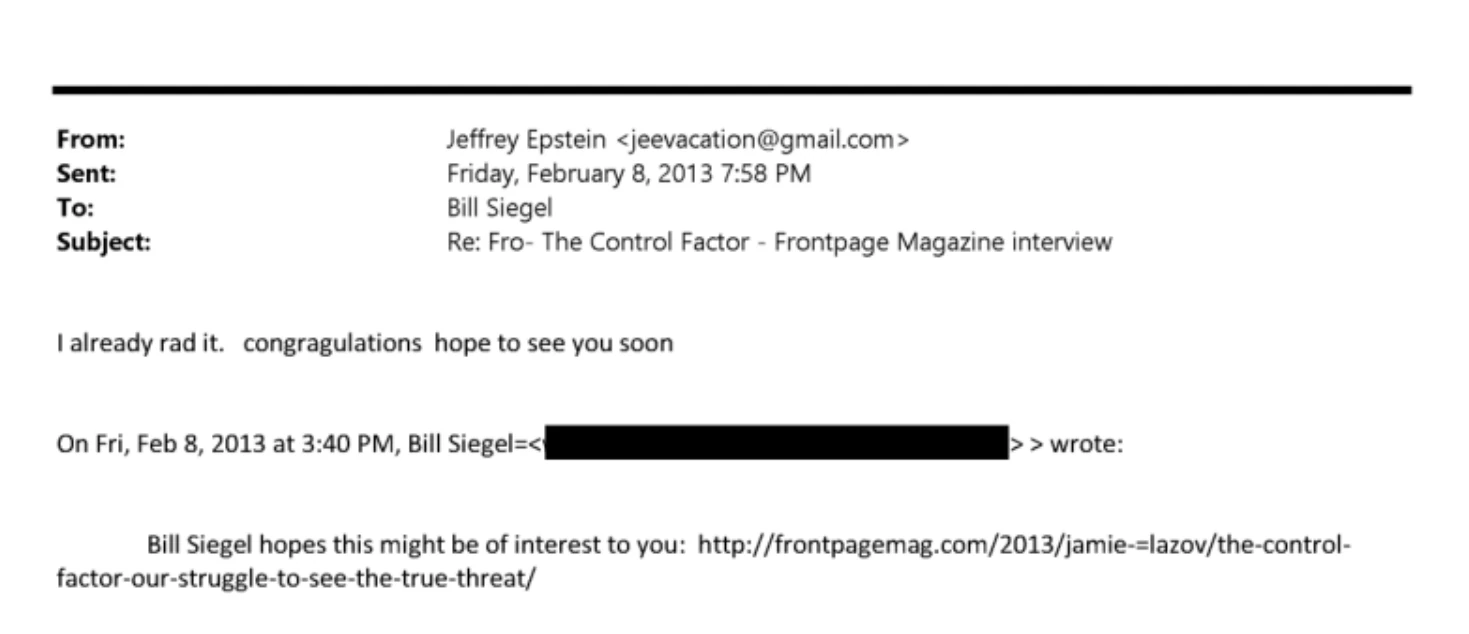
Siegel spends much of the interview describing what he calls the “Islamic Enemy,” and he treats that enemy as something already working through American life. He writes about government, universities, the military and the legal system as places where this danger can take hold, then calls part of it “Civilization Jihad.” He also describes the United Nations and other international institutions as forces that can push America toward choices he sees as dangerous. By the time he turns fully to Israel, the interview has trained the reader to distrust restraint.
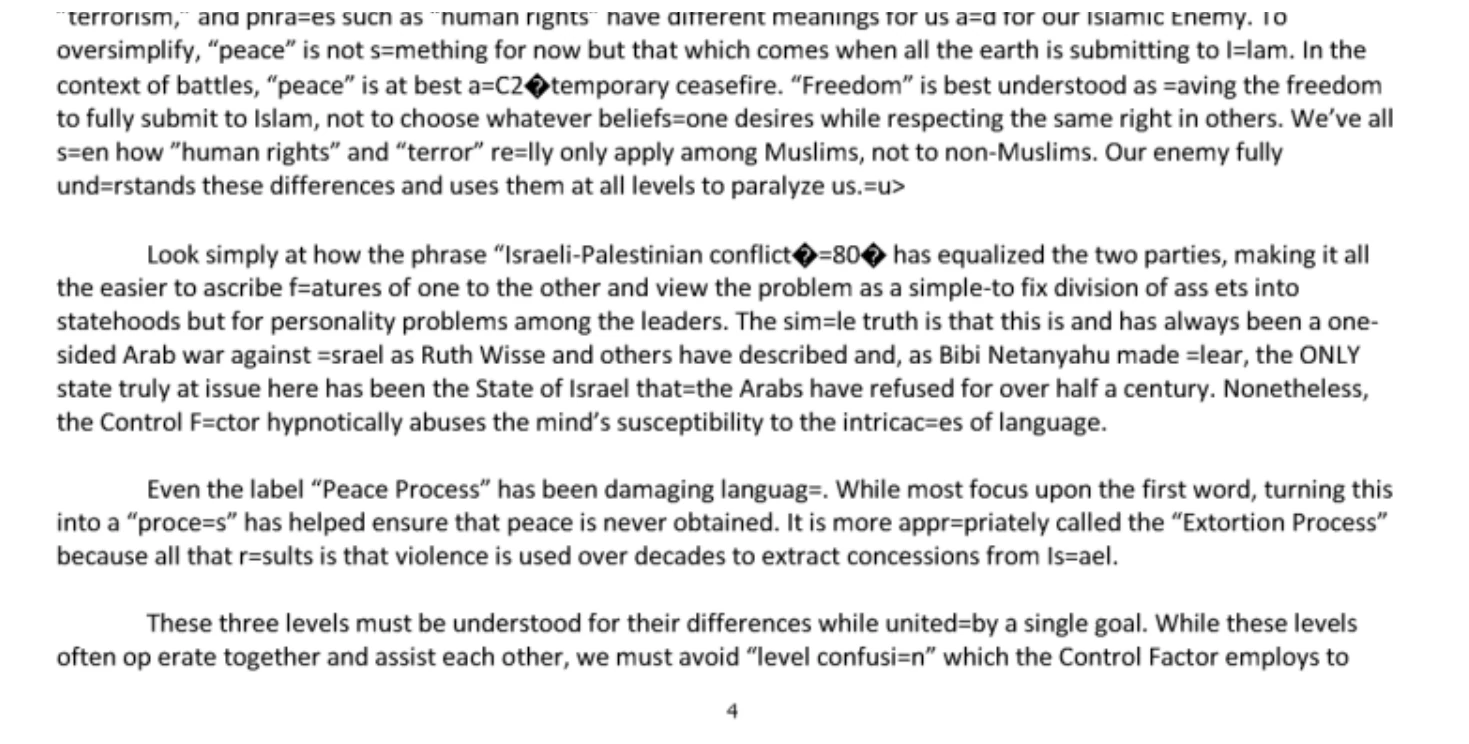
Siegel rejects even the phrase “Israeli-Palestinian conflict” because he says it creates a false equality between the two sides. He calls the history a one-sided Arab war against Israel and says the peace process should be called the “Extortion Process.” In his telling, Palestinian violence extracts concessions while the West keeps misunderstanding what it is watching. Palestinians barely exist in this section as people living through the violence he is describing.
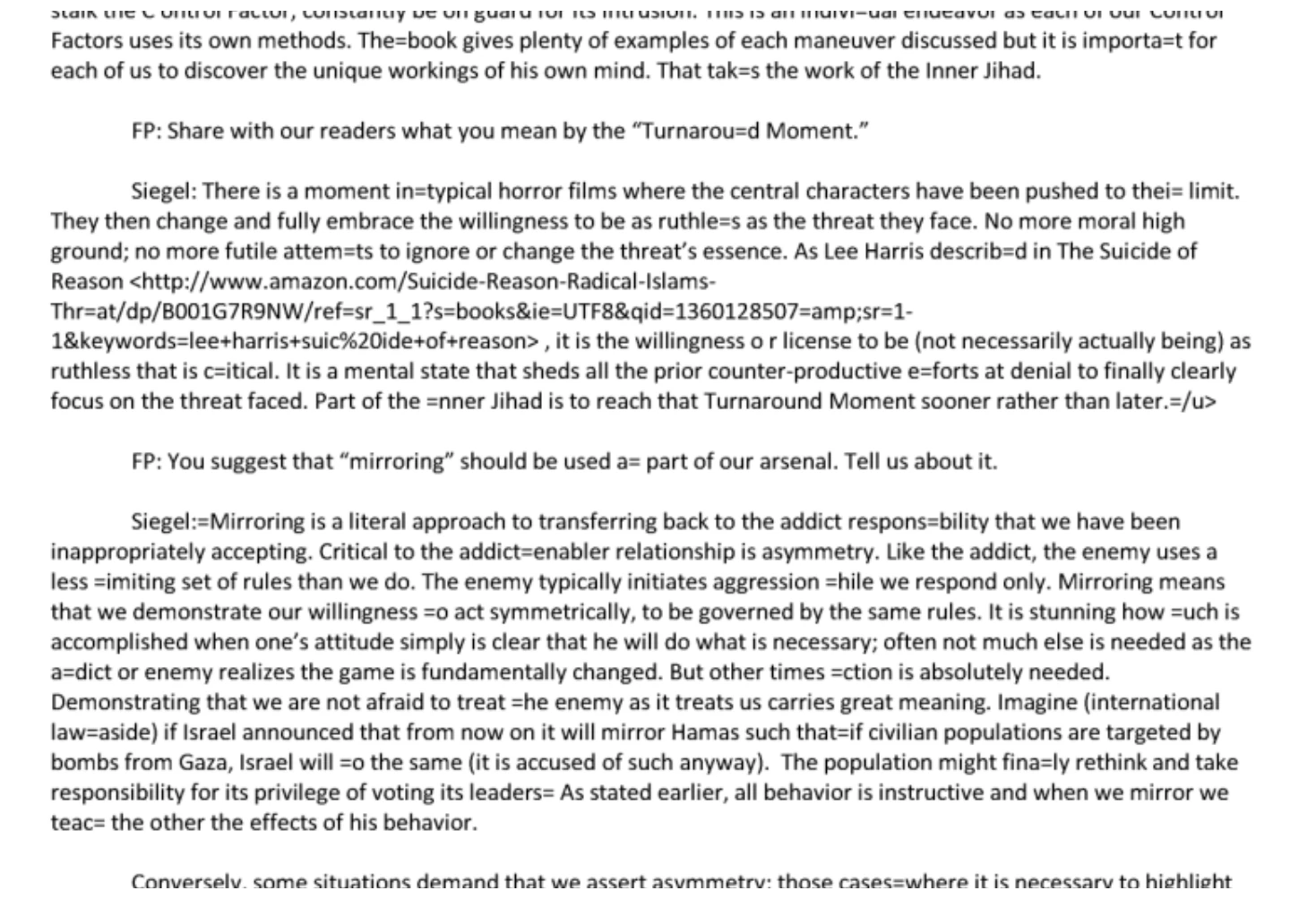
A few pages later, he explains what he calls the “Turnaround Moment,” and I had to stop reading for a minute. Siegel says people eventually have to become willing to be “as ruthless as the threat” they think they are facing. He treats that willingness as something necessary for survival after other responses have failed. Then he reaches for Gaza to show the reader what that willingness might mean in practice.
He calls the next idea “mirroring,” which means showing the enemy that the same rules can be used against it. Siegel asks the reader to imagine Israel announcing that if civilian populations are targeted by bombs from Gaza, Israel will do the same in return. Before giving that example, he literally writes “international law aside.” He then suggests that the population might reconsider its choices once civilians are made to feel the consequences.
That was written in February 2013, and Gaza is now the site of a genocide carried out by the Israeli government. In September 2025, the UN Independent International Commission of Inquiry concluded that Israel had committed genocide in Gaza. Amnesty International had already reached the same conclusion after its own investigation. Both spent months examining what Israel did and the intent behind it before using that word.
The United States has helped keep that genocide going by continuing to arm Israel and protect it from international pressure. This month, Reuters reported that the Trump administration is planning another $2.8 billion munitions sale that includes forty thousand two-thousand-pound bombs. The United States also cast the only vote against a September 2025 Security Council resolution demanding an immediate, unconditional and permanent ceasefire, its sixth Gaza-related veto. Now the administration is preparing sanctions against the International Criminal Court while trying to pressure the court over arrest warrants involving Israeli leaders.
I keep reading Siegel’s words beside those facts, and every time I do, I get angrier. He writes about Israel as though restraint itself is the danger, then puts Gaza civilians inside an argument for reciprocal punishment. He tells the reader to imagine international law moved out of the way before Israel answers attacks on civilians by attacking civilians in return. Thirteen years later, my own government is still sending the weapons while fighting institutions that try to impose consequences.
American power keeps bending around this relationship in ways I no longer find defensible. Then I find this email sitting in the Epstein files from 2013, with the language already there on the page. Gaza civilians are inside an argument about becoming ruthless, while international law is pushed aside before the example even begins. Epstein says he read it, congratulates Siegel, and tells him he hopes to see him soon.
I keep coming back to the ordinary tone of Epstein’s reply because it sits above something so ugly. He answers Siegel with a casual congratulations and says he hopes to see him soon. The page beneath that reply still contains the Gaza example and the words “international law aside.” I am reading it after the genocide in Gaza, while the United States continues arming the government carrying it out.
Source note
The email establishes that Epstein told Siegel he had already read the linked interview. It does not establish that Epstein agreed with every sentence. The current-event passages above are the author's analysis and rely on the sources below.
- UN Independent International Commission of Inquiry, September 16, 2025. The Commission concluded that Israeli authorities and security forces committed genocide against Palestinians in Gaza.
- Amnesty International, December 5, 2024. Amnesty concluded that Israel had committed genocide against Palestinians in Gaza.
- Reuters, September 15, 2026. Reuters reported a planned $2.8 billion U.S. munitions sale to Israel, including 20,000 MK-84 and 20,000 BLU-117 two-thousand-pound bombs.
- Reuters, September 18, 2025. The United States cast the only vote against a Security Council resolution demanding an immediate, unconditional and permanent ceasefire.
- Reuters, September 20, 2026. Reuters reported that the Trump administration was preparing sanctions against the International Criminal Court.
- International Court of Justice, South Africa v. Israel. The Court has issued provisional measures; a final merits judgment has not yet been issued.
Israel rejects the genocide findings and says its military operations are directed at Hamas. That dispute is recorded here because the article makes a legal and political claim that readers should be able to trace to the underlying sources.